
Pearson+ LogoPearson+ Logo
Ch. 7 Photosynthesis: Using Light to Make Food
Taylor - Campbell Biology: Concepts & Connections 10th Edition
Taylor, Simon, Dickey, Hogan10th EditionCampbell Biology: Concepts & ConnectionsISBN: 9780136538783Not the one you use?Change textbook
Chapter 7, Problem 8

How is photosynthesis similar in C4 plants and CAM plants?
a. In both cases, the light reactions and the Calvin cycle are separated in both time and location.
b. Both types of plants make sugar without the Calvin cycle.
c. In both cases, rubisco is not used to fix carbon initially.
d. Both types of plants make most of their sugar in the dark.

Verified step by step guidance
1
Understand the process of photosynthesis: Photosynthesis consists of two main stages—the light reactions and the Calvin cycle. The light reactions capture energy from sunlight, while the Calvin cycle uses that energy to fix carbon dioxide into sugars.
Learn about C4 plants: C4 plants have a specialized mechanism to minimize photorespiration. They initially fix carbon dioxide into a four-carbon compound using an enzyme called PEP carboxylase, which is more efficient than rubisco in low CO2 conditions. The Calvin cycle occurs in specialized bundle-sheath cells.
Learn about CAM plants: CAM plants also minimize photorespiration but do so by separating the processes of carbon fixation and the Calvin cycle in time. They fix carbon dioxide into a four-carbon compound at night when stomata are open, and then use it during the day for the Calvin cycle when stomata are closed.
Compare the similarities: Both C4 and CAM plants initially fix carbon dioxide using PEP carboxylase instead of rubisco, which helps them avoid photorespiration. This is a key similarity between the two types of plants.
Analyze the options: Based on the understanding of C4 and CAM plants, the correct answer is likely option c, as both types of plants initially fix carbon using PEP carboxylase rather than rubisco.

Verified video answer for a similar problem:

This video solution was recommended by our tutors as helpful for the problem above.
Video duration:
5m
Was this helpful?

Key Concepts

Here are the essential concepts you must grasp in order to answer the question correctly.

Photosynthesis

Photosynthesis is the process by which green plants, algae, and some bacteria convert light energy into chemical energy, specifically glucose, using carbon dioxide and water. This process occurs in two main stages: the light-dependent reactions, which capture energy from sunlight, and the light-independent reactions, or Calvin cycle, which synthesizes glucose. Understanding this process is crucial for comparing different plant adaptations.
Recommended video:
Guided course
05:58
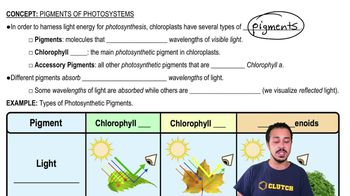
Pigments of Photosynthesis

C4 and CAM Pathways

C4 and CAM (Crassulacean Acid Metabolism) are two adaptations that allow plants to efficiently fix carbon dioxide in environments with high temperatures and low water availability. C4 plants separate the initial carbon fixation and the Calvin cycle spatially, while CAM plants separate these processes temporally, fixing carbon at night. Both adaptations help minimize photorespiration and water loss, making them vital for survival in challenging conditions.
Recommended video:
Guided course
04:34
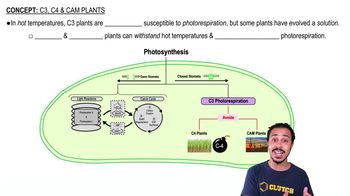
C3, C4 & CAM Plants

Rubisco and Carbon Fixation

Rubisco (ribulose-1,5-bisphosphate carboxylase/oxygenase) is the enzyme responsible for fixing carbon dioxide in the Calvin cycle. In C4 and CAM plants, initial carbon fixation occurs through different mechanisms that do not involve Rubisco, allowing these plants to optimize carbon capture under specific environmental conditions. Understanding the role of Rubisco is essential for grasping how these plants adapt their photosynthetic processes.
Recommended video: