
Pearson+ LogoPearson+ Logo
Ch. 7 Photosynthesis: Using Light to Make Food
Taylor - Campbell Biology: Concepts & Connections 10th Edition
Taylor, Simon, Dickey, Hogan10th EditionCampbell Biology: Concepts & ConnectionsISBN: 9780136538783Not the one you use?Change textbook
Chapter 7, Problem 7

Why is it difficult for C3 plants to carry out photosynthesis in very hot, dry environments such as deserts?
a. The light is too intense and destroys the pigment molecules.
b. The closing of stomata keeps CO₂ from entering and O₂ from leaving the plant.
c. They must rely on photorespiration to make ATP.
d. CO₂ builds up in the leaves, blocking carbon fixation.

Verified step by step guidance
1
Understand the role of stomata in plants: Stomata are small openings on the surface of leaves that allow for gas exchange. They let CO2 enter for photosynthesis and O2 exit as a byproduct. However, in hot and dry environments, plants often close their stomata to prevent water loss through transpiration.
Recognize the consequence of closed stomata: When stomata are closed, CO2 cannot enter the leaf, and O2 produced during photosynthesis cannot leave. This leads to a decrease in the availability of CO2 for the Calvin cycle, which is essential for carbon fixation.
Understand the process of photorespiration: In the absence of sufficient CO2, the enzyme RuBisCO (ribulose-1,5-bisphosphate carboxylase-oxygenase) starts binding to O2 instead of CO2. This process, called photorespiration, reduces the efficiency of photosynthesis because it does not produce sugars and wastes energy.
Analyze why this is a problem for C3 plants: C3 plants rely solely on the Calvin cycle for carbon fixation. They do not have specialized mechanisms, like C4 or CAM plants, to concentrate CO2 or minimize photorespiration. As a result, they struggle to carry out photosynthesis effectively in hot, dry environments.
Conclude the correct answer: Based on the above explanation, the difficulty for C3 plants in such environments arises because the closing of stomata prevents CO2 from entering and O2 from leaving, leading to increased photorespiration and reduced photosynthetic efficiency. This corresponds to option b.

Verified video answer for a similar problem:

This video solution was recommended by our tutors as helpful for the problem above.
Video duration:
1m
Was this helpful?

Key Concepts

Here are the essential concepts you must grasp in order to answer the question correctly.

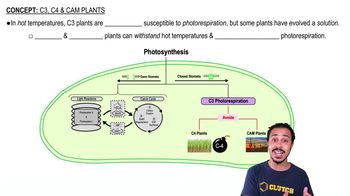
C3 Photosynthesis

C3 photosynthesis is the most common pathway for carbon fixation in plants, where CO2 is converted into a three-carbon compound, 3-phosphoglycerate (3-PGA). This process occurs in the chloroplasts and relies on the enzyme RuBisCO. C3 plants are efficient in cool, moist environments but struggle in hot, dry conditions due to increased photorespiration.
Recommended video:
Guided course
04:34
C3, C4 & CAM Plants

Stomatal Regulation

Stomata are small openings on the leaf surface that regulate gas exchange, allowing CO2 to enter and O2 to exit. In hot, dry environments, C3 plants often close their stomata to prevent water loss, which inadvertently limits CO2 intake. This trade-off can severely hinder photosynthesis and lead to reduced plant productivity.
Recommended video:
Guided course
03:31
Cell Cycle Regulation

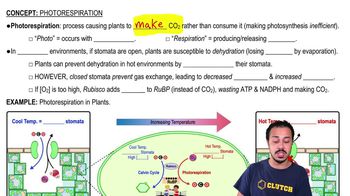
Photorespiration

Photorespiration is a process that occurs when RuBisCO fixes oxygen instead of carbon dioxide, leading to the production of a two-carbon compound instead of the desired three-carbon compound. This process is wasteful, as it consumes energy and releases CO2, making it particularly problematic for C3 plants in hot, dry conditions where CO2 levels are low and O2 levels are high.
Recommended video:
Guided course
14:32
Photorespiration