
Pearson+ LogoPearson+ Logo
Ch. 36 Population Ecology
Taylor - Campbell Biology: Concepts & Connections 10th Edition
Taylor, Simon, Dickey, Hogan10th EditionCampbell Biology: Concepts & ConnectionsISBN: 9780136538783Not the one you use?Change textbook
Chapter 36, Problem 12

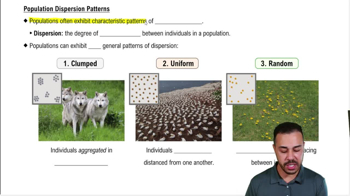
Describe the factors that might produce the following three types of dispersion patterns in populations. Three circles showing different population dispersion patterns: clumped, uniform, and random.

Verified step by step guidance
1
Identify the three types of dispersion patterns shown in the image: clumped, uniform, and random.
For the clumped dispersion pattern (left circle), consider factors such as resource availability, social behavior, and environmental conditions that might cause individuals to group together.
For the uniform dispersion pattern (middle circle), think about factors like territorial behavior, competition for resources, and human intervention that might lead to evenly spaced individuals.
For the random dispersion pattern (right circle), reflect on the absence of strong attractions or repulsions among individuals and the uniform availability of resources that might result in a random distribution.
Summarize how these factors influence the dispersion patterns in populations, emphasizing the role of ecological and behavioral factors in shaping these patterns.

Verified video answer for a similar problem:

This video solution was recommended by our tutors as helpful for the problem above.
Video duration:
2m
Was this helpful?

Key Concepts

Here are the essential concepts you must grasp in order to answer the question correctly.

Population Dispersion Patterns

Population dispersion patterns describe how individuals in a population are spatially arranged in their environment. The three main types are clumped, uniform, and random. Clumped dispersion occurs when individuals group together due to resource availability or social behavior. Uniform dispersion results from competition for resources, leading to evenly spaced individuals. Random dispersion happens when individuals are distributed without a predictable pattern, often due to the absence of strong social interactions or resource limitations.
Recommended video:
Guided course
02:44
Population Dispersion Patterns

Environmental Factors

Environmental factors play a crucial role in determining the dispersion patterns of populations. These factors include the availability of resources such as food, water, and shelter, as well as the presence of predators and competitors. For instance, clumped patterns may arise in areas where resources are abundant, while uniform patterns can result from competition for limited resources. Understanding these factors helps explain why populations are distributed in specific ways across different habitats.
Recommended video:
Guided course
03:48
Environmental Factors Affecting Enzyme Activity

Biotic and Abiotic Interactions

Biotic interactions (relationships between living organisms) and abiotic factors (non-living environmental components) significantly influence population dispersion. Biotic factors include predation, competition, and symbiosis, which can lead to clumped or uniform patterns. Abiotic factors such as climate, soil type, and topography can also affect how populations are spread out. Recognizing the interplay between these interactions is essential for understanding the dynamics of population distribution in various ecosystems.
Recommended video:
Guided course
06:59
Biotic and Abiotic Factors
Related Practice
Textbook Question

According to data on ecological footprints

a. The carrying capacity of the world is 10 billion

b. Earth's resources are sufficient to sustain future generations at current levels of consumption

c. The ecological footprint of individuals in the United States is more than twice the world average

d. Nations with the largest ecological footprints have the fastest population growth rates

1661
views
Textbook Question

What are some factors that might have a density-dependent limiting effect on population growth?

1993
views
Textbook Question

What is survivorship?

What does a survivorship curve show?

Explain what the three survivorship curves tell us about humans, squirrels, and clams.

2578
views
Textbook Question
The mountain gorilla, spotted owl, giant panda, snow leopard, and grizzly bear are all endangered by human encroachment on their environments. Another thing these animals have in common is their K-selected life history traits. Why might they be more easily endangered than animals with r-selected life history traits? What general type of survivorship curve would you expect these species to exhibit? Explain your answer.
1348
views
Textbook Question

Another hypothesis for snowshoe hare population cycles proposes that they are caused by sunspot activity. According to this hypothesis, sunspot activity affects the chemicals present in the plants eaten by hares, which in turn affects the quality of the food.

What testable predictions are generated by this hypothesis?

1038
views
Textbook Question

Many people regard the rapid population growth of developing countries as our most serious environmental problem. Others think that the growth of developed countries, though slower, is actually a greater threat to the environment. What kinds of environmental problems result from population growth in

(a) developing countries and

(b) developed countries?

Which do you think is the greater threat? Why?

1133
views