
Pearson+ LogoPearson+ Logo
Ch. 36 Population Ecology
Taylor - Campbell Biology: Concepts & Connections 10th Edition
Taylor, Simon, Dickey, Hogan10th EditionCampbell Biology: Concepts & ConnectionsISBN: 9780136538783Not the one you use?Change textbook
Chapter 36, Problem 10

What are some factors that might have a density-dependent limiting effect on population growth?

Verified step by step guidance
1
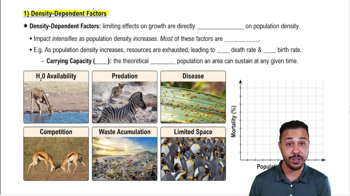
Understand the concept of density-dependent factors: These are factors that affect population growth based on the population's density. As the population size increases, these factors become more significant in limiting growth.
Identify examples of density-dependent factors: Common examples include competition for resources (such as food, water, and shelter), predation, disease, and parasitism. These factors intensify as population density rises.
Explain how competition works: When a population grows, individuals compete more intensely for limited resources. This can lead to reduced reproduction rates, increased mortality, or migration to less crowded areas.
Discuss the role of disease and parasitism: Higher population density facilitates the spread of diseases and parasites, as individuals are in closer contact with one another. This can reduce population size by increasing mortality rates.
Consider predation: Predators may target denser populations because they are easier to locate. This can lead to a decrease in population size as predation rates increase with density.

Verified video answer for a similar problem:

This video solution was recommended by our tutors as helpful for the problem above.
Video duration:
1m
Was this helpful?

Key Concepts

Here are the essential concepts you must grasp in order to answer the question correctly.

Density-Dependent Factors

Density-dependent factors are environmental influences that affect population growth in relation to the population's density. As a population increases, these factors, such as competition for resources, predation, disease, and waste accumulation, become more pronounced, leading to a decrease in growth rate. For example, in a crowded habitat, individuals may struggle for food, resulting in lower reproductive success.
Recommended video:
Guided course
02:37
Density-Dependent Factors

Carrying Capacity

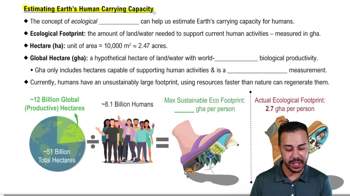
Carrying capacity refers to the maximum number of individuals of a species that an environment can sustainably support. It is influenced by the availability of resources such as food, water, and shelter. When a population exceeds its carrying capacity, density-dependent factors often lead to increased mortality or decreased reproduction, stabilizing the population size.
Recommended video:
Guided course
06:24
Estimating Earth’s Human Carrying Capacity

Population Dynamics

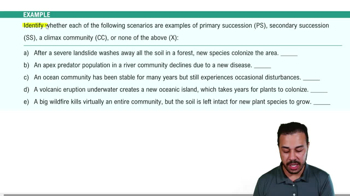
Population dynamics is the study of how and why populations change over time, influenced by factors such as birth rates, death rates, immigration, and emigration. Understanding these dynamics helps explain how density-dependent factors can regulate population growth, leading to fluctuations in population size and structure. This concept is crucial for predicting future population trends and managing wildlife resources.
Recommended video:
Guided course
03:01
Community Dynamics Example 1
Related Practice
Textbook Question

Which of the following represents a demographic transition?

a. A population switches from exponential to logistic growth

b. A population reaches a fertility rate of zero

c. There are equal numbers of individuals in all age groups

d. A population switches from high birth and death rates to low birth and death rates

1994
views
Textbook Question

Skyrocketing growth of the human population appears to be mainly a result of

a. A drop in death rate due to sanitation and health care

b. Better nutrition boosting the birth rate

c. The concentration of humans in cities

d. Social changes that make it desirable to have more children

1571
views
Textbook Question

According to data on ecological footprints

a. The carrying capacity of the world is 10 billion

b. Earth's resources are sufficient to sustain future generations at current levels of consumption

c. The ecological footprint of individuals in the United States is more than twice the world average

d. Nations with the largest ecological footprints have the fastest population growth rates

1661
views
Textbook Question

What is survivorship?

What does a survivorship curve show?

Explain what the three survivorship curves tell us about humans, squirrels, and clams.

2578
views
Textbook Question
Describe the factors that might produce the following three types of dispersion patterns in populations.

1573
views
Textbook Question
The mountain gorilla, spotted owl, giant panda, snow leopard, and grizzly bear are all endangered by human encroachment on their environments. Another thing these animals have in common is their K-selected life history traits. Why might they be more easily endangered than animals with r-selected life history traits? What general type of survivorship curve would you expect these species to exhibit? Explain your answer.
1348
views