
Pearson+ LogoPearson+ Logo
Ch. 36 Population Ecology
Taylor - Campbell Biology: Concepts & Connections 10th Edition
Taylor, Simon, Dickey, Hogan10th EditionCampbell Biology: Concepts & ConnectionsISBN: 9780136538783Not the one you use?Change textbook
Chapter 36, Problem 11

What is survivorship?
What does a survivorship curve show?
Explain what the three survivorship curves tell us about humans, squirrels, and clams.

Verified step by step guidance
1
Survivorship refers to the proportion of individuals in a population that survive to a certain age. It is a key concept in population ecology and helps us understand patterns of survival and mortality within a species.
A survivorship curve is a graphical representation that shows the number or proportion of individuals surviving at each age for a given species or population. It helps visualize how survival rates change over the lifespan of organisms.
There are three main types of survivorship curves: Type I, Type II, and Type III. Each type reflects different survival strategies and life history traits.
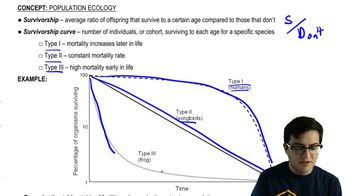
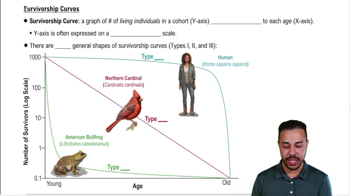
Type I survivorship curve (e.g., humans): This curve is characterized by high survival rates during early and middle life, followed by a steep decline in survival in older age. It indicates that most individuals live to old age due to low mortality rates during youth and adulthood, often seen in species with parental care and fewer offspring.
Type II survivorship curve (e.g., squirrels): This curve shows a constant rate of mortality throughout the lifespan, meaning the likelihood of dying is roughly the same at any age. Type III survivorship curve (e.g., clams): This curve is marked by very high mortality rates early in life, with few individuals surviving to adulthood. Species with this curve often produce many offspring but provide little to no parental care.

Verified video answer for a similar problem:

This video solution was recommended by our tutors as helpful for the problem above.
Video duration:
2m
Was this helpful?

Key Concepts

Here are the essential concepts you must grasp in order to answer the question correctly.

Survivorship

Survivorship refers to the proportion of individuals in a population that survive to a certain age. It is a key concept in ecology and demography, helping to understand population dynamics and life history strategies. Survivorship can be influenced by various factors, including environmental conditions, predation, and reproductive strategies.
Recommended video:

Survivorship Curves

Survivorship curves are graphical representations that illustrate the number of individuals surviving at each age for a given species. There are three main types of survivorship curves: Type I (high survival in early and middle life, with a steep decline in older age), Type II (constant mortality rate throughout life), and Type III (high mortality in early life, with survivors living longer). These curves provide insights into the reproductive strategies and life expectancy of different species.
Recommended video:
Guided course
02:54
Survivorship Curves

Comparative Analysis of Survivorship Curves

The analysis of different survivorship curves reveals important ecological and biological traits of species. For example, humans typically exhibit a Type I curve, indicating high survival rates in early life, while squirrels may show a Type II curve, reflecting a relatively constant mortality rate. Clams, on the other hand, often display a Type III curve, suggesting high mortality in early stages but potential longevity for those that survive. This comparative analysis helps in understanding the adaptive strategies of various organisms.
Recommended video:
Guided course
02:54
Survivorship Curves
Related Practice
Textbook Question

Skyrocketing growth of the human population appears to be mainly a result of

a. A drop in death rate due to sanitation and health care

b. Better nutrition boosting the birth rate

c. The concentration of humans in cities

d. Social changes that make it desirable to have more children

1571
views
Textbook Question

According to data on ecological footprints

a. The carrying capacity of the world is 10 billion

b. Earth's resources are sufficient to sustain future generations at current levels of consumption

c. The ecological footprint of individuals in the United States is more than twice the world average

d. Nations with the largest ecological footprints have the fastest population growth rates

1661
views
Textbook Question

What are some factors that might have a density-dependent limiting effect on population growth?

1993
views
Textbook Question
Describe the factors that might produce the following three types of dispersion patterns in populations.

1573
views
Textbook Question
The mountain gorilla, spotted owl, giant panda, snow leopard, and grizzly bear are all endangered by human encroachment on their environments. Another thing these animals have in common is their K-selected life history traits. Why might they be more easily endangered than animals with r-selected life history traits? What general type of survivorship curve would you expect these species to exhibit? Explain your answer.
1348
views
Textbook Question

Another hypothesis for snowshoe hare population cycles proposes that they are caused by sunspot activity. According to this hypothesis, sunspot activity affects the chemicals present in the plants eaten by hares, which in turn affects the quality of the food.

What testable predictions are generated by this hypothesis?

1038
views