
Pearson+ LogoPearson+ Logo
Ch. 36 Population Ecology
Taylor - Campbell Biology: Concepts & Connections 10th Edition
Taylor, Simon, Dickey, Hogan10th EditionCampbell Biology: Concepts & ConnectionsISBN: 9780136538783Not the one you use?Change textbook
Chapter 36, Problem 4

To figure out the human population density of your community, you would need to know the number of people living there and
a. The land area in which they live
b. The birth rate of the population
c. The dispersion pattern of the population
d. The carrying capacity

Verified step by step guidance
1
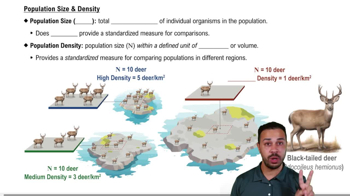
Understand the concept of population density: Population density is defined as the number of individuals living in a specific area divided by the size of that area. It is typically expressed as individuals per unit area.
Identify the key variables needed to calculate population density: You need the total number of people living in the community and the total land area they occupy.
Eliminate irrelevant options: The birth rate (option b) refers to the number of births per unit time and does not directly relate to population density. The dispersion pattern (option c) describes how individuals are distributed within the area but does not provide a numerical value for density. The carrying capacity (option d) refers to the maximum population size an environment can sustain, which is unrelated to the current density calculation.
Focus on the correct variable: The land area (option a) is the relevant factor because population density is calculated as the number of people divided by the land area they occupy.
Conclude that to calculate the human population density of your community, you need the number of people living there and the land area in which they live (option a).

Verified video answer for a similar problem:

This video solution was recommended by our tutors as helpful for the problem above.
Video duration:
2m
Was this helpful?

Key Concepts

Here are the essential concepts you must grasp in order to answer the question correctly.

Population Density

Population density is a measure of the number of individuals living in a given area, typically expressed as people per square kilometer or mile. It provides insight into how crowded or sparse a community is, which can influence resource availability, social dynamics, and urban planning.
Recommended video:
Guided course
01:52
Population Size & Density

Land Area

Land area refers to the total surface area of a specific region where the population resides. It is a critical factor in calculating population density, as the number of individuals is divided by the land area to determine how densely populated an area is.
Recommended video:

Carrying Capacity

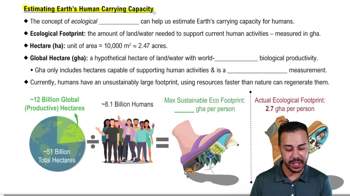
Carrying capacity is the maximum number of individuals that an environment can sustainably support without degrading the habitat. Understanding carrying capacity helps in assessing whether a population is living within its means or if it is at risk of overpopulation and resource depletion.
Recommended video:
Guided course
06:24
Estimating Earth’s Human Carrying Capacity
Related Practice
Textbook Question

Use this graph of the idealized exponential and logistic growth curves to complete the following.

a. Label the axes and curves on the graph.

b. Give the formula that describes the blue curve.

c. What does the dotted line represent?

d. For each curve, indicate and explain where population growth is the most rapid.

e. Which of these curves best represents global human population growth?

1921
views
Textbook Question

The graph below shows the demographic transition for a hypothetical country. Many developed countries that have achieved a stable population size have undergone a transition similar to this. Answer the following questions concerning this graph.

a. What does the blue line represent? The red line?

b. This diagram has been divided into four sections.

Describe what is happening in each section.

c. In which section(s) is the population size stable?

d. In which section is the population growth rate the highest?

1655
views
Textbook Question

After seeds have sprouted, gardeners often pull up some of the seedlings so that only a few grow to maturity. How does this practice help produce the best yield?

a. By increasing K

b. By decreasing r

c. By reducing intraspecific competition

d. By adding a density-independent factor to the environment

998
views
Textbook Question

The term (K−N)/K

a. Is the carrying capacity for a population.

b. Is greatest when K is very large.

c. Is zero when population size equals carrying capacity.

d. Increases in value as N approaches K.

2514
views
Textbook Question

With regard to its rate of growth, a population that is growing logistically

a. Grows fastest when density is lowest

b. Has a high intrinsic rate of increase

c. Grows fastest at an intermediate population density

d. Grows fastest as it approaches carrying capacity

2096
views
Textbook Question

Which of the following represents a demographic transition?

a. A population switches from exponential to logistic growth

b. A population reaches a fertility rate of zero

c. There are equal numbers of individuals in all age groups

d. A population switches from high birth and death rates to low birth and death rates

1994
views