Pearson+ LogoPearson+ Logo
Ch. 36 Population Ecology
Taylor - Campbell Biology: Concepts & Connections 10th Edition
Taylor, Simon, Dickey, Hogan10th EditionCampbell Biology: Concepts & ConnectionsISBN: 9780136538783Not the one you use?Change textbook
Chapter 36, Problem 5

The term (K−N)/K
a. Is the carrying capacity for a population.
b. Is greatest when K is very large.
c. Is zero when population size equals carrying capacity.
d. Increases in value as N approaches K.

Verified step by step guidance
1
Step 1: Begin by identifying the components of the term (K−N)/K. Here, K represents the carrying capacity of a population, and N represents the current population size.
Step 2: Understand the biological significance of the term (K−N). This represents the difference between the carrying capacity (K) and the current population size (N). When N is equal to K, the difference becomes zero, indicating that the population has reached its carrying capacity.
Step 3: Divide (K−N) by K to normalize the difference relative to the carrying capacity. This term essentially measures how far the population is from reaching its carrying capacity as a proportion of K.
Step 4: Analyze the behavior of the term (K−N)/K under different conditions: (a) When N equals K, the term becomes zero, indicating no growth potential. (b) When N is much smaller than K, the term approaches 1, indicating high growth potential. (c) As N approaches K, the term decreases in value, reflecting reduced growth potential.
Step 5: Use the above analysis to evaluate the options provided in the problem. For example, option (c) aligns with the observation that (K−N)/K equals zero when N equals K, and option (d) contradicts the fact that the term decreases as N approaches K.

Verified video answer for a similar problem:

This video solution was recommended by our tutors as helpful for the problem above.
Video duration:
1m
Was this helpful?

Key Concepts

Here are the essential concepts you must grasp in order to answer the question correctly.

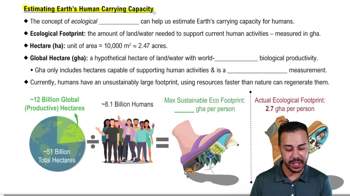
Carrying Capacity (K)

Carrying capacity (K) refers to the maximum number of individuals of a species that an environment can sustainably support. It is determined by factors such as resource availability, habitat space, and environmental conditions. Understanding K is crucial for analyzing population dynamics and predicting how populations grow or decline over time.
Recommended video:
Guided course
06:24
Estimating Earth’s Human Carrying Capacity

Population Size (N)

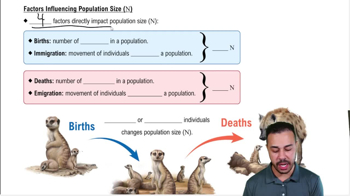
Population size (N) is the current number of individuals in a population. It fluctuates due to births, deaths, immigration, and emigration. The relationship between N and K is vital for understanding population growth; as N approaches K, the growth rate slows, reflecting the limitations imposed by the environment.
Recommended video:
Guided course
01:48
Factors Affecting Population Size (N)

Logistic Growth Model

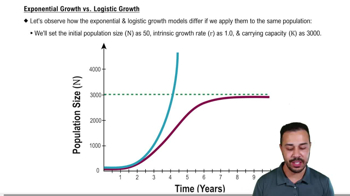
The logistic growth model describes how populations grow in an environment with limited resources. It is characterized by an initial exponential growth phase, followed by a slowdown as the population reaches its carrying capacity (K). The formula (K−N)/K represents the fraction of resources available for growth, which decreases as N approaches K, indicating that growth becomes limited.
Recommended video:
Guided course
09:46
Exponential Growth vs. Logistic Growth
Related Practice
Textbook Question

The graph below shows the demographic transition for a hypothetical country. Many developed countries that have achieved a stable population size have undergone a transition similar to this. Answer the following questions concerning this graph.

a. What does the blue line represent? The red line?

b. This diagram has been divided into four sections.

Describe what is happening in each section.

c. In which section(s) is the population size stable?

d. In which section is the population growth rate the highest?

1655
views
Textbook Question

After seeds have sprouted, gardeners often pull up some of the seedlings so that only a few grow to maturity. How does this practice help produce the best yield?

a. By increasing K

b. By decreasing r

c. By reducing intraspecific competition

d. By adding a density-independent factor to the environment

998
views
Textbook Question

To figure out the human population density of your community, you would need to know the number of people living there and

a. The land area in which they live

b. The birth rate of the population

c. The dispersion pattern of the population

d. The carrying capacity

1295
views
Textbook Question

With regard to its rate of growth, a population that is growing logistically

a. Grows fastest when density is lowest

b. Has a high intrinsic rate of increase

c. Grows fastest at an intermediate population density

d. Grows fastest as it approaches carrying capacity

2096
views
Textbook Question

Which of the following represents a demographic transition?

a. A population switches from exponential to logistic growth

b. A population reaches a fertility rate of zero

c. There are equal numbers of individuals in all age groups

d. A population switches from high birth and death rates to low birth and death rates

1994
views
Textbook Question

Skyrocketing growth of the human population appears to be mainly a result of

a. A drop in death rate due to sanitation and health care

b. Better nutrition boosting the birth rate

c. The concentration of humans in cities

d. Social changes that make it desirable to have more children

1571
views