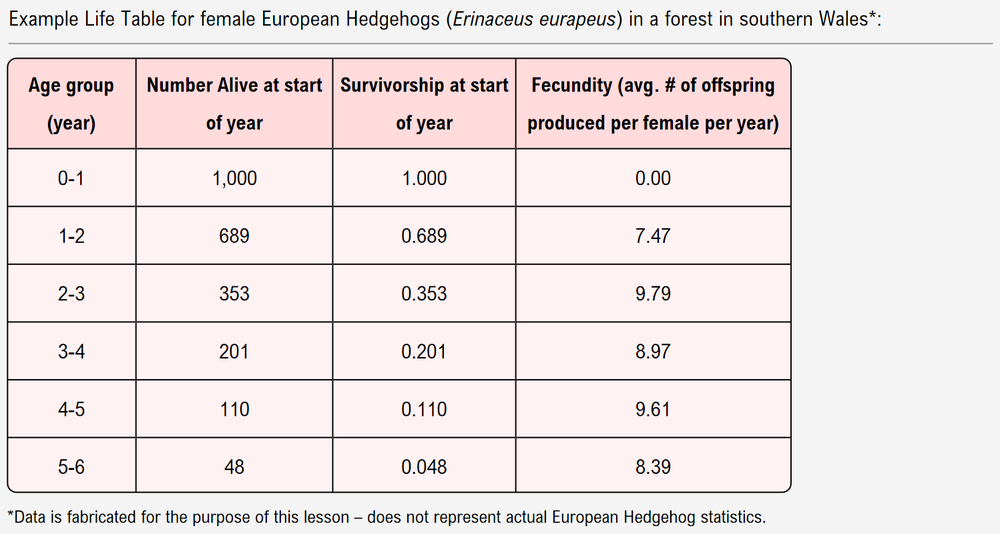
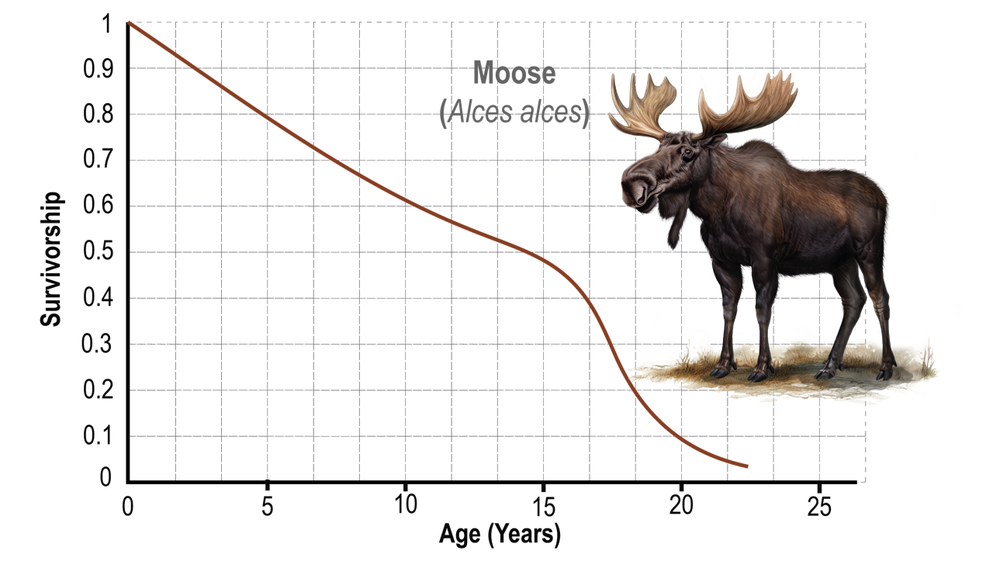
Life tables are essential tools in demography that provide a comprehensive statistical overview of a population's survivorship, mortality, and reproductive rates. A cohort, defined as a group of individuals of the same species born around the same time, is typically analyzed in these tables. In studies of sexually reproducing organisms, life tables often focus on females, as they are the ones who produce offspring and significantly influence population dynamics.
For instance, consider a life table for female fruit flies, Drosophila melanogaster, which examines a cohort of 500 females aged between 0 and 10 days. The table tracks these fruit flies until all have died, collecting various statistical data along the way. Key components of a life table include:
- Age Interval: The specific age range being analyzed.
- Number of Organisms Alive: The count of individuals alive at the beginning of each age interval.
- Overall Survivorship: The proportion of the original cohort that remains alive at the start of each age interval.
- Overall Mortality Rate: The death rate between age intervals, calculated as the number of deaths divided by the initial number of organisms.
- Fecundity: The reproductive capacity, often represented as the average number of female offspring produced per female.
To illustrate, if 500 female fruit flies are observed and 134 die in the first age interval (0-10 days), the mortality rate can be calculated as:
Mortality Rate = \(\frac{134}{500} = 0.268\) or 26.8%.
In the next age interval (20-30 days), if 280 organisms are still alive, the survivorship is calculated as:
Survivorship = \(\frac{280}{500} = 0.560\) or 56%.
Continuing this process, if the survivorship at the start of the 30-40 day interval is 0.248, the number of organisms alive can be determined by:
Number Alive = \(0.248 \times 500 = 124\).
Understanding life tables is crucial for analyzing population dynamics and predicting future trends in species populations. As you practice these concepts, you'll gain a deeper insight into the factors that influence survival and reproduction within a population.