Pearson+ LogoPearson+ Logo
Ch. 8 The Cellular Basis of Reproduction and Inheritance
Taylor - Campbell Biology: Concepts & Connections 10th Edition
Taylor, Simon, Dickey, Hogan10th EditionCampbell Biology: Concepts & ConnectionsISBN: 9780136538783Not the one you use?Change textbook
Chapter 8, Problem 8

A biochemist measured the amount of DNA in cells growing in the laboratory and found that the quantity of DNA in a cell doubled
a. Between prophase and anaphase of mitosis
b. Between the G1 and G2 phases of the cell cycle
c. During the M phase of the cell cycle
d. Between prophase I and prophase II of meiosis

Verified step by step guidance
1
Understand the context of the problem: The biochemist is measuring the amount of DNA in cells and observing when the DNA quantity doubles. This doubling occurs during DNA replication, which is a key event in the cell cycle.
Recall the phases of the cell cycle: The cell cycle consists of interphase (G1, S, and G2 phases) and the M phase (mitosis or meiosis). DNA replication occurs during the S phase (synthesis phase) of interphase, which is between the G1 and G2 phases.
Analyze the options: Option (a) refers to mitosis, where DNA is already replicated before prophase begins. Option (b) refers to the G1 and G2 phases, which are separated by the S phase where DNA replication occurs. Option (c) refers to the M phase, where DNA is divided but not replicated. Option (d) refers to meiosis, where DNA replication occurs before prophase I, not between prophase I and prophase II.
Focus on the correct phase: DNA doubling occurs during the S phase, which is part of interphase and specifically between the G1 and G2 phases. This matches option (b).
Conclude: The correct answer is that the DNA quantity doubles between the G1 and G2 phases of the cell cycle, as this is when DNA replication occurs during the S phase.

Verified video answer for a similar problem:

This video solution was recommended by our tutors as helpful for the problem above.
Video duration:
1m
Was this helpful?

Key Concepts

Here are the essential concepts you must grasp in order to answer the question correctly.

Mitosis

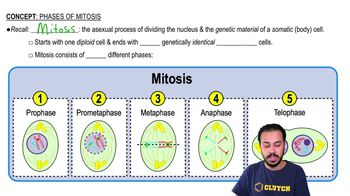
Mitosis is the process of cell division that results in two genetically identical daughter cells from a single parent cell. It consists of several phases: prophase, metaphase, anaphase, and telophase. During mitosis, the DNA is replicated during the S phase of the cell cycle, and the actual separation of the duplicated chromosomes occurs during anaphase.
Recommended video:
Guided course
03:21
Phases of Mitosis

Cell Cycle

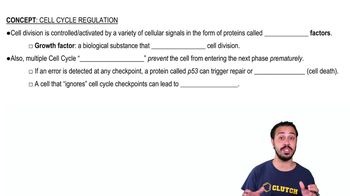
The cell cycle is a series of phases that a cell goes through to grow and divide. It includes the G1 phase (cell growth), S phase (DNA synthesis), G2 phase (preparation for mitosis), and M phase (mitosis and cytokinesis). The G1 to G2 transition is crucial for DNA replication, where the amount of DNA in the cell doubles in preparation for division.
Recommended video:
Guided course
03:31
Cell Cycle Regulation

Meiosis

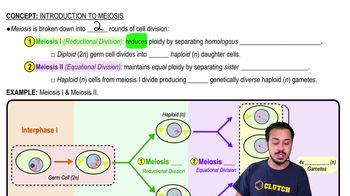
Meiosis is a specialized form of cell division that reduces the chromosome number by half, resulting in four non-identical gametes. It consists of two rounds of division: meiosis I and meiosis II. During prophase I, homologous chromosomes pair and exchange genetic material, but the DNA does not double again between prophase I and prophase II, making it distinct from mitosis.
Recommended video:
Guided course
04:49
Meiosis I & Meiosis II
Related Practice
Textbook Question

A fruit fly somatic cell contains 8 chromosomes. This means that ___________ different combinations of chromosomes are possible in its gametes.

a. 8

b. 16

c. 32

d. 64

3538
views
Textbook Question

If a fragment of a chromosome breaks off and then reattaches to the original chromosome but in the reverse direction, the resulting chromosomal abnormality is called

a. A deletion

b. An inversion

c. A translocation

d. A non-disjunction

1547
views
Textbook Question

Which of the following phases of mitosis is essentially the opposite of prophase in terms of changes within the nucleus?

a. Telophase

b. Metaphase

c. Interphase

d. Anaphase

1871
views
Textbook Question

A micrograph of a dividing cell from a mouse showed 19 chromosomes, each consisting of two sister chromatids. During which of the following stages of cell division could such a picture have been taken? (Explain your answer.)

a. Prophase of mitosis

b. Telophase II of meiosis

c. Prophase I of meiosis

d. Prophase II of meiosis

1517
views
Textbook Question

Cytochalasin B is a chemical that disrupts microfilament formation. This chemical would interfere with:

a. DNA replication

b. Formation of the mitotic spindle

c. Cleavage

d. Formation of the cell plate

2298
views
Textbook Question

Why are individuals with an extra chromosome 21, which causes Down syndrome, more numerous than individuals with an extra chromosome 3 or chromosome 16?

a. There are probably more genes on chromosome 21 than on the others.

b. Chromosome 21 is a sex chromosome, and chromosomes 3 and 16 are not.

c. Down syndrome is not more common, just more serious.

d. Extra copies of the other chromosomes are probably fatal.

2229
views