
Pearson+ LogoPearson+ Logo
Ch. 8 The Cellular Basis of Reproduction and Inheritance
Taylor - Campbell Biology: Concepts & Connections 10th Edition
Taylor, Simon, Dickey, Hogan10th EditionCampbell Biology: Concepts & ConnectionsISBN: 9780136538783Not the one you use?Change textbook
Chapter 8, Problem 12

In the light micrograph below of dividing cells near the tip of an onion root, identify a cell in interphase, prophase, metaphase, anaphase, and telophase. Describe the major events occurring at each stage.
<IMAGE>

Verified step by step guidance
1
Examine the light micrograph carefully to identify cells in different stages of the cell cycle. Look for visual cues such as chromatin condensation, spindle formation, and chromosome alignment.
Identify a cell in interphase: Look for a cell with a clearly defined nucleus and chromatin that appears uncondensed. During interphase, the cell is preparing for division by replicating its DNA and organelles.
Identify a cell in prophase: Look for a cell where the chromatin has started to condense into visible chromosomes, and the nuclear envelope begins to break down. Spindle fibers may start forming.
Identify a cell in metaphase: Look for a cell where the chromosomes are aligned along the metaphase plate (the center of the cell). Spindle fibers are fully formed and attached to the centromeres of the chromosomes.
Identify a cell in anaphase and telophase: For anaphase, look for a cell where sister chromatids are being pulled apart toward opposite poles of the cell. For telophase, look for a cell where the chromosomes have reached the poles, the nuclear envelope is reforming, and the cell is preparing to divide into two daughter cells.

Verified video answer for a similar problem:

This video solution was recommended by our tutors as helpful for the problem above.
Video duration:
1m
Was this helpful?

Key Concepts

Here are the essential concepts you must grasp in order to answer the question correctly.

Cell Cycle Stages

The cell cycle consists of several stages that a cell goes through to divide and replicate. These stages include interphase, where the cell prepares for division, and the mitotic phases: prophase, metaphase, anaphase, and telophase. Understanding these stages is crucial for identifying the specific events and characteristics of cells during division.
Recommended video:
Guided course
03:16
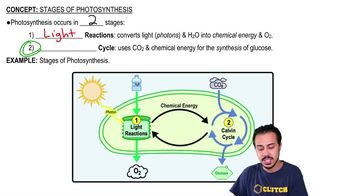
Stages of Photosynthesis

Mitosis

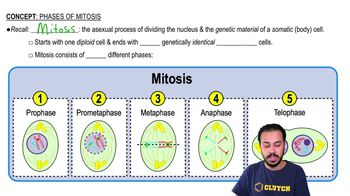
Mitosis is the process of nuclear division that results in two identical daughter cells. It is divided into several phases: prophase (chromosomes condense and become visible), metaphase (chromosomes align at the cell's equator), anaphase (sister chromatids are pulled apart), and telophase (nuclear membranes reform around the separated chromosomes). Each phase has distinct morphological features that can be observed under a microscope.
Recommended video:
Guided course
03:21
Phases of Mitosis

Chromosome Structure

Chromosomes are structures made of DNA and proteins that carry genetic information. During cell division, they undergo significant changes in structure, becoming more condensed and visible during prophase. Understanding chromosome structure and behavior during mitosis is essential for identifying the stages of cell division and the events that occur at each stage.
Recommended video:
Guided course
08:09
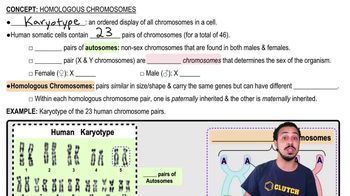
Homologous Chromosomes
Related Practice
Textbook Question

A micrograph of a dividing cell from a mouse showed 19 chromosomes, each consisting of two sister chromatids. During which of the following stages of cell division could such a picture have been taken? (Explain your answer.)

a. Prophase of mitosis

b. Telophase II of meiosis

c. Prophase I of meiosis

d. Prophase II of meiosis

1517
views
Textbook Question

Cytochalasin B is a chemical that disrupts microfilament formation. This chemical would interfere with:

a. DNA replication

b. Formation of the mitotic spindle

c. Cleavage

d. Formation of the cell plate

2298
views
Textbook Question

Why are individuals with an extra chromosome 21, which causes Down syndrome, more numerous than individuals with an extra chromosome 3 or chromosome 16?

a. There are probably more genes on chromosome 21 than on the others.

b. Chromosome 21 is a sex chromosome, and chromosomes 3 and 16 are not.

c. Down syndrome is not more common, just more serious.

d. Extra copies of the other chromosomes are probably fatal.

2229
views
Textbook Question
An organism called a plasmodial slime mold is one large cytoplasmic mass with many nuclei. Explain how such a 'megacell' could form.
1890
views
Textbook Question
Briefly describe how three different processes that occur during a sexual life cycle increase the genetic diversity of offspring.
1524
views
Textbook Question

Discuss the factors that control the division of eukaryotic cells grown in the laboratory. Cancer cells are easier to grow in the lab than other cells.

Why do you suppose this is?

1547
views