Pearson+ LogoPearson+ Logo
Ch. 4 A Tour of the Cell
Taylor - Campbell Biology: Concepts & Connections 10th Edition
Taylor, Simon, Dickey, Hogan10th EditionCampbell Biology: Concepts & ConnectionsISBN: 9780136538783Not the one you use?Change textbook
Chapter 4, Problem 1

Label the structures in this diagram of an animal cell. Review the functions of each of these organelles.
<IMAGE>

Verified step by step guidance
1
Step 1: Identify the labeled structures in the diagram. For example, 'a' represents the nucleus, 'b' represents the nucleolus, 'c' represents the nuclear envelope, and so on. Each label corresponds to a specific organelle within the animal cell.
Step 2: Review the function of each organelle. For instance, the nucleus ('a') houses the cell's genetic material (DNA) and controls cellular activities. The nucleolus ('b') is involved in ribosome production, and the nuclear envelope ('c') protects the nucleus and regulates the exchange of materials between the nucleus and cytoplasm.
Step 3: Continue labeling and describing functions. For example, 'd' represents the rough endoplasmic reticulum, which is involved in protein synthesis and modification. 'e' represents the smooth endoplasmic reticulum, which is involved in lipid synthesis and detoxification.
Step 4: Label and describe additional organelles. For example, 'f' represents the mitochondria, which are the powerhouse of the cell and generate ATP through cellular respiration. 'g' represents the cytoskeleton, which provides structural support and facilitates intracellular transport.
Step 5: Complete the labeling and review functions of remaining organelles. For example, 'h' represents lysosomes, which contain enzymes for breaking down waste materials. 'i' represents peroxisomes, which are involved in lipid metabolism and detoxification. 'j' represents the plasma membrane, which regulates the movement of substances in and out of the cell. 'k' represents the Golgi apparatus, which modifies, sorts, and packages proteins and lipids for transport.

Verified video answer for a similar problem:

This video solution was recommended by our tutors as helpful for the problem above.
Video duration:
1m
Was this helpful?

Key Concepts

Here are the essential concepts you must grasp in order to answer the question correctly.

Animal Cell Structure

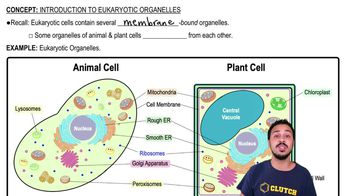
Animal cells are eukaryotic cells characterized by a defined nucleus and various organelles, each with specific functions. Key structures include the nucleus, which houses genetic material; mitochondria, known as the powerhouses of the cell for energy production; and the endoplasmic reticulum, involved in protein and lipid synthesis. Understanding these structures is essential for identifying their roles in cellular function.
Recommended video:
Guided course
08:52
Prokaryotic Cell Structures 3

Organelle Functions

Organelles are specialized subunits within a cell that perform distinct functions necessary for the cell's survival and operation. For example, lysosomes contain enzymes for digestion, while the Golgi apparatus modifies and packages proteins for secretion. Familiarity with these functions helps in labeling and understanding the diagram of an animal cell.
Recommended video:
Guided course
03:45
Introduction to Eukaryotic Organelles

Cellular Processes

Cellular processes refer to the various biochemical activities that occur within a cell, including metabolism, protein synthesis, and cell division. These processes are facilitated by the organelles and are crucial for maintaining homeostasis and responding to environmental changes. Recognizing how these processes interconnect aids in comprehending the overall function of the cell as depicted in the diagram.
Recommended video:
Guided course
04:19
1) RNA Processing