Pearson+ LogoPearson+ Logo
Ch. 4 A Tour of the Cell
Taylor - Campbell Biology: Concepts & Connections 10th Edition
Taylor, Simon, Dickey, Hogan10th EditionCampbell Biology: Concepts & ConnectionsISBN: 9780136538783Not the one you use?Change textbook
Chapter 4, Problem 3

The cells of an ant and an elephant are, on average, the same small size; an elephant just has more of them. What is the main advantage of small cell size? (Explain your reasoning.)
a. A small cell has a larger plasma membrane surface area than does a large cell.
b. Small cells can better take up sufficient nutrients and oxygen to service their cell volume.
c. It takes less energy to make an organism out of small cells.
d. Small cells require less oxygen than do large cells.

Verified step by step guidance
1
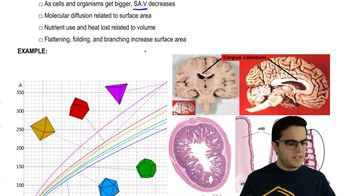
Understand the relationship between cell size and surface area-to-volume ratio. As cells get smaller, their surface area-to-volume ratio increases, which is crucial for efficient exchange of materials like nutrients and oxygen.
Analyze option (a): A small cell does not necessarily have a larger plasma membrane surface area than a large cell. Instead, the surface area-to-volume ratio is higher in small cells, which facilitates better material exchange.
Evaluate option (b): Small cells can better take up sufficient nutrients and oxygen because their higher surface area-to-volume ratio allows for more efficient diffusion and transport processes relative to their volume.
Consider option (c): While energy efficiency might be a factor in some contexts, the main advantage of small cell size is related to material exchange rather than energy expenditure in making an organism.
Assess option (d): Small cells do not inherently require less oxygen than large cells; rather, their size allows them to efficiently acquire oxygen and nutrients to meet their metabolic needs.

Verified video answer for a similar problem:

This video solution was recommended by our tutors as helpful for the problem above.
Video duration:
2m
Was this helpful?

Key Concepts

Here are the essential concepts you must grasp in order to answer the question correctly.

Surface Area to Volume Ratio

The surface area to volume ratio is a critical concept in cell biology that describes how the surface area of a cell relates to its volume. Smaller cells have a higher surface area relative to their volume, which facilitates more efficient exchange of materials, such as nutrients and waste, with their environment. This ratio is vital for cellular functions, as it impacts the cell's ability to absorb substances and expel waste.
Recommended video:
Guided course
07:47
Surface Area to Volume Ratio

Nutrient and Oxygen Uptake

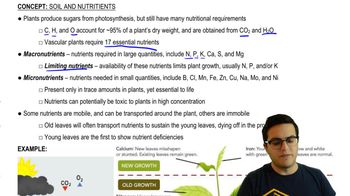
Small cells can more effectively take up nutrients and oxygen due to their higher surface area to volume ratio. This allows for quicker diffusion of essential substances into the cell, ensuring that metabolic processes can occur efficiently. In contrast, larger cells may struggle to transport enough nutrients and oxygen to meet their metabolic demands, leading to inefficiencies.
Recommended video:
Guided course
03:25
Soil Nutrients

Energy Efficiency in Cell Production

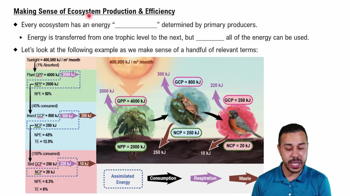
Creating smaller cells can be more energy-efficient for an organism. Smaller cells require less energy to maintain and replicate compared to larger cells, which need more resources to support their greater volume. This efficiency can be advantageous for organisms, allowing them to allocate energy towards growth, reproduction, and other vital processes.
Recommended video:
Guided course
07:47
Making Sense of Ecosystem Production & Efficiency