Pearson+ LogoPearson+ Logo
Ch. 5 The Working Cell
Taylor - Campbell Biology: Concepts & Connections 10th Edition
Taylor, Simon, Dickey, Hogan10th EditionCampbell Biology: Concepts & ConnectionsISBN: 9780136538783Not the one you use?Change textbook
Chapter 5, Problem 1

Fill in the following concept map to review the processes by which molecules move across membranes.
<IMAGE?

Verified step by step guidance
1
Step 1: Begin by identifying the two main mechanisms by which molecules cross cell membranes: passive transport and active transport. Passive transport does not require energy, while active transport requires ATP.
Step 2: For passive transport, determine the two subcategories: diffusion and facilitated diffusion. Diffusion involves the movement of molecules down their concentration gradient without the help of proteins, while facilitated diffusion involves the use of transport proteins.
Step 3: Fill in the concept map for diffusion by noting that it involves the movement of small, nonpolar molecules such as oxygen and carbon dioxide (labeled as (c) in the map).
Step 4: For facilitated diffusion, recognize that it involves the movement of polar molecules and ions (labeled as (d) in the map) through specific transport proteins embedded in the membrane.
Step 5: For active transport, identify that it involves the movement of molecules against their concentration gradient (labeled as (b) in the map) and requires ATP. Active transport uses specific transport proteins (labeled as (e) in the map) to move molecules across the membrane.

Verified video answer for a similar problem:

This video solution was recommended by our tutors as helpful for the problem above.
Video duration:
31s
Was this helpful?

Key Concepts

Here are the essential concepts you must grasp in order to answer the question correctly.

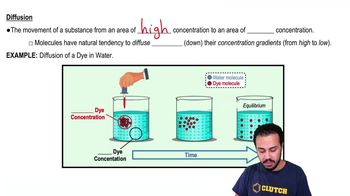
Diffusion

Diffusion is the passive movement of molecules from an area of higher concentration to an area of lower concentration. This process occurs until equilibrium is reached and does not require energy. It is a fundamental mechanism for the transport of small, nonpolar molecules, such as oxygen and carbon dioxide, across cell membranes.
Recommended video:

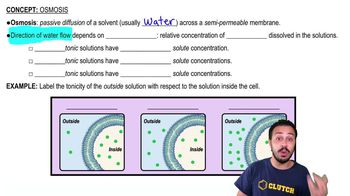
Osmosis

Osmosis is a specific type of diffusion that refers to the movement of water molecules through a selectively permeable membrane. Water moves from an area of lower solute concentration to an area of higher solute concentration, aiming to balance solute levels on both sides of the membrane. This process is crucial for maintaining cell turgor and overall homeostasis.
Recommended video:

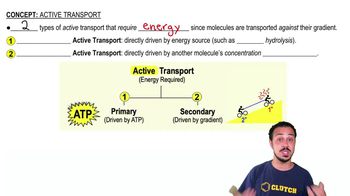
Active Transport

Active transport is the process by which molecules move across a membrane against their concentration gradient, requiring energy, usually in the form of ATP. This mechanism is essential for transporting ions and larger molecules that cannot passively diffuse through the membrane, such as glucose and sodium ions, thereby maintaining cellular functions and homeostasis.
Recommended video:
Guided course
02:37
Active Transport