Pearson+ LogoPearson+ Logo
Ch. 5 The Working Cell
Taylor - Campbell Biology: Concepts & Connections 10th Edition
Taylor, Simon, Dickey, Hogan10th EditionCampbell Biology: Concepts & ConnectionsISBN: 9780136538783Not the one you use?Change textbook
Chapter 5, Problem 3

Which best describes the structure of a cell membrane?
a. Proteins between two bilayers of phospholipids
b. Proteins embedded in a bilayer of phospholipids
c. A bilayer of protein coating a layer of phospholipids
d. Cholesterol embedded in a bilayer of phospholipids

Verified step by step guidance
1
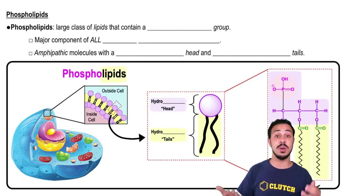
Understand the basic structure of a cell membrane: The cell membrane is primarily composed of a phospholipid bilayer, which forms the fundamental framework. This bilayer is amphipathic, meaning it has hydrophilic (water-attracting) heads and hydrophobic (water-repelling) tails.
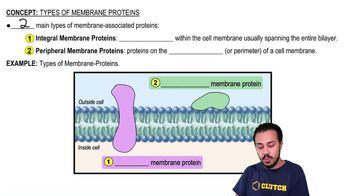
Recognize the role of proteins in the membrane: Proteins are embedded within the phospholipid bilayer. These proteins can either span the entire bilayer (integral proteins) or be attached to the surface (peripheral proteins). They play roles in transport, signaling, and structural support.
Consider the role of cholesterol: Cholesterol molecules are interspersed within the phospholipid bilayer. They help maintain membrane fluidity and stability, especially in varying temperatures.
Eliminate incorrect options: Option (a) is incorrect because proteins are not located between two bilayers of phospholipids. Option (c) is incorrect because the bilayer is made of phospholipids, not proteins. Option (d) is partially correct but does not fully describe the structure, as it omits the role of proteins.
Select the best answer: Option (b) is correct because it accurately describes the structure of the cell membrane as proteins embedded in a bilayer of phospholipids.

Verified video answer for a similar problem:

This video solution was recommended by our tutors as helpful for the problem above.
Video duration:
1m
Was this helpful?

Key Concepts

Here are the essential concepts you must grasp in order to answer the question correctly.

Phospholipid Bilayer

The cell membrane is primarily composed of a phospholipid bilayer, which consists of two layers of phospholipids. Each phospholipid has a hydrophilic (water-attracting) 'head' and two hydrophobic (water-repelling) 'tails.' This arrangement allows the membrane to be fluid and flexible, creating a barrier that separates the interior of the cell from the external environment.
Recommended video:
Guided course
04:05
Phospholipids

Membrane Proteins

Proteins are integral components of the cell membrane, either embedded within the phospholipid bilayer or attached to its surface. These membrane proteins serve various functions, including transport of substances, acting as receptors for signaling molecules, and facilitating cell recognition. Their presence is crucial for the membrane's functionality and interaction with the environment.
Recommended video:
Guided course
02:35
Types of Membrane Proteins

Fluid Mosaic Model

The fluid mosaic model describes the structure of the cell membrane as a dynamic and flexible arrangement of various components, including phospholipids, proteins, and cholesterol. This model emphasizes that the membrane is not static; instead, the proteins and lipids can move laterally within the layer, contributing to the membrane's fluidity and functionality in cellular processes.
Recommended video:
Guided course
01:09
Introduction to Population Growth Models