Pearson+ LogoPearson+ Logo
Ch. 5 The Working Cell
Taylor - Campbell Biology: Concepts & Connections 10th Edition
Taylor, Simon, Dickey, Hogan10th EditionCampbell Biology: Concepts & ConnectionsISBN: 9780136538783Not the one you use?Change textbook
Chapter 5, Problem 4

A plant cell placed in distilled water will ______________; an animal cell placed in distilled water will ______________.
a. Burst … burst
b. Become flaccid … shrivel
c. Become turgid … be normal in shape
d. Become turgid … burst

Verified step by step guidance
1
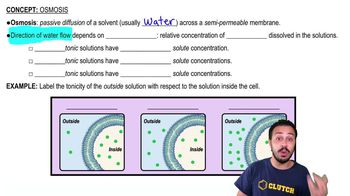
Understand the concept of osmosis: Osmosis is the movement of water across a selectively permeable membrane from an area of lower solute concentration to an area of higher solute concentration.
Recognize the difference between plant and animal cells: Plant cells have a rigid cell wall that provides structural support, while animal cells lack a cell wall and only have a flexible plasma membrane.
Analyze the effect of distilled water on plant cells: Distilled water is hypotonic (lower solute concentration compared to the cell's cytoplasm). Water will move into the plant cell, causing it to swell and become turgid due to the pressure exerted by the cell wall.
Analyze the effect of distilled water on animal cells: In the absence of a cell wall, water entering the animal cell in a hypotonic environment will cause the cell to swell and eventually burst (lyse) due to the lack of structural support.
Match the observations to the answer choices: Based on the analysis, the correct answer is 'd. become turgid . . . burst,' as plant cells become turgid and animal cells burst when placed in distilled water.

Verified video answer for a similar problem:

This video solution was recommended by our tutors as helpful for the problem above.
Video duration:
4m
Was this helpful?

Key Concepts

Here are the essential concepts you must grasp in order to answer the question correctly.

Osmosis

Osmosis is the movement of water molecules across a selectively permeable membrane from an area of lower solute concentration to an area of higher solute concentration. This process is crucial for maintaining cell turgor in plants and the overall balance of fluids in animal cells. Understanding osmosis helps explain how cells respond to different environments, such as when placed in distilled water.
Recommended video:

Turgor Pressure

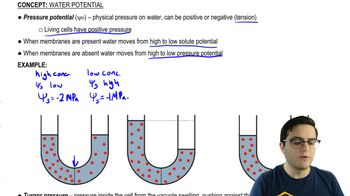
Turgor pressure is the pressure exerted by the fluid inside the central vacuole of a plant cell against the cell wall. This pressure is essential for maintaining the structural integrity and rigidity of plant cells. When a plant cell is placed in distilled water, it absorbs water, increasing turgor pressure, which can lead to the cell becoming turgid.
Recommended video:
Guided course
11:58
Pressure Potential and Turgidity

Cell Membrane Permeability

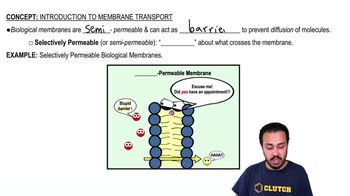
Cell membrane permeability refers to the ability of the cell membrane to allow certain substances to pass through while blocking others. In animal cells, the membrane is more permeable to water than to solutes, which can lead to osmotic imbalances. When an animal cell is placed in distilled water, it may take in too much water, potentially causing it to burst due to the lack of a rigid cell wall.
Recommended video:
Guided course
02:47
Introduction to Membrane Transport