Pearson+ LogoPearson+ Logo
Ch. 16 - How Genes Work
Freeman - Biological Science 7th Edition
Freeman7th EditionBiological ScienceISBN: 9783584863285Not the one you use?Change textbook
Chapter 16, Problem 9a

Draw a hypothetical metabolic pathway in Neurospora crassa composed of five substrates, five enzymes, and a product called nirvana. Number the substrates 1–5, and label the enzymes A–E, in order. (For instance, enzyme A catalyzes the reaction between substrates 1 and 2.)
(a) Suppose a mutation made the gene for enzyme C nonfunctional. What molecule would accumulate in the affected cells?

Verified step by step guidance
1
Step 1: Understand the structure of the metabolic pathway. In this pathway, there are five substrates (1 to 5) and five enzymes (A to E). Each enzyme catalyzes a reaction between two substrates, leading to the next substrate in the sequence.
Step 2: Visualize the pathway as a sequence of reactions: Substrate 1 is converted to Substrate 2 by Enzyme A, Substrate 2 to Substrate 3 by Enzyme B, Substrate 3 to Substrate 4 by Enzyme C, Substrate 4 to Substrate 5 by Enzyme D, and finally, Substrate 5 to the product 'nirvana' by Enzyme E.
Step 3: Identify the role of Enzyme C in the pathway. Enzyme C is responsible for converting Substrate 3 into Substrate 4.
Step 4: Consider the effect of a nonfunctional Enzyme C. If Enzyme C is nonfunctional due to a mutation, it cannot catalyze the conversion of Substrate 3 to Substrate 4.
Step 5: Determine which molecule would accumulate. Since Substrate 3 cannot be converted to Substrate 4, Substrate 3 will accumulate in the cells as it is not being processed further in the pathway.

Verified video answer for a similar problem:

This video solution was recommended by our tutors as helpful for the problem above.
Video duration:
2m
Was this helpful?

Key Concepts

Here are the essential concepts you must grasp in order to answer the question correctly.

Metabolic Pathways

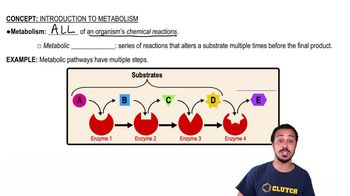
A metabolic pathway is a series of chemical reactions occurring within a cell, where the product of one reaction serves as the substrate for the next. Enzymes catalyze each step, ensuring the pathway proceeds efficiently. Understanding the sequence of substrates and enzymes is crucial for predicting the effects of mutations or disruptions in the pathway.
Recommended video:
Guided course
02:17
Introduction to Metabolism

Enzyme Function and Mutation

Enzymes are biological catalysts that speed up chemical reactions without being consumed. Each enzyme is specific to a particular reaction. A mutation in the gene encoding an enzyme can lead to a nonfunctional enzyme, halting the pathway at that step. This results in the accumulation of the substrate that the enzyme would normally convert.
Recommended video:
Guided course
02:32
Functions of Enzymes

Genetic Mutations and Phenotypic Effects

Genetic mutations are changes in the DNA sequence that can affect gene function. In the context of metabolic pathways, a mutation in an enzyme-coding gene can disrupt the pathway, leading to the accumulation of substrates and potentially causing a phenotypic effect. Understanding these mutations helps in predicting metabolic disorders and their consequences.
Recommended video:
Related Practice
Textbook Question
Explain what's wrong with this statement: All point mutations change the genotype and the phenotype.
891
views
Textbook Question
Draw a hypothetical metabolic pathway in Neurospora crassa composed of five substrates, five enzymes, and a product called nirvana. Number the substrates 1–5, and label the enzymes A–E, in order. (For instance, enzyme A catalyzes the reaction between substrates 1 and 2.) (a) Suppose a mutation made the gene for enzyme C nonfunctional. What molecule would accumulate in the affected cells?
1378
views
Textbook Question
Draw a hypothetical metabolic pathway in Neurospora crassa composed of five substrates, five enzymes, and a product called nirvana. Number the substrates 1–5, and label the enzymes A–E, in order. (For instance, enzyme A catalyzes the reaction between substrates 1 and 2.) (b) Suppose a mutant strain can survive if substrate 5 is added to the growth medium, but it cannot grow if substrates 1, 2, 3, or 4 are added. Which enzyme in the pathway is affected in this mutant?
1553
views
Textbook Question

Draw a hypothetical metabolic pathway in Neurospora crassa composed of five substrates, five enzymes, and a product called nirvana. Number the substrates 1–5, and label the enzymes A–E, in order. (For instance, enzyme A catalyzes the reaction between substrates 1 and 2.)

(b) Suppose a mutant strain can survive if substrate 5 is added to the growth medium, but it cannot grow if substrates 1, 2, 3, or 4 are added. Which enzyme in the pathway is affected in this mutant?

894
views
Textbook Question

One of the possibilities considered about the genetic code was that the code was overlapping, meaning that a single base could be part of up to three codons. How many amino acids would be encoded in the sequence 5′-AUGUUACGGAAU-3′ by a non-overlapping and a maximally overlapping triplet code?

a. 4 (non-overlapping) and 16 (overlapping)

b. 4 and 12

c. 4 and 10

d. 12 and 4

1551
views
Textbook Question
One of the possibilities considered about the genetic code was that the code was overlapping, meaning that a single base could be part of up to three codons. How many amino acids would be encoded in the sequence 5′-AUGUUACGGAAU-3′ by a non-overlapping and a maximally overlapping triplet code?a. 4 (non-overlapping) and 16 (overlapping)b. 4 and 12c. 4 and 10d. 12 and 4
1915
views