Pearson+ LogoPearson+ Logo
Ch. 16 - How Genes Work
Freeman - Biological Science 7th Edition
Freeman7th EditionBiological ScienceISBN: 9783584863285Not the one you use?Change textbook
Chapter 16, Problem 9

Draw a hypothetical metabolic pathway in Neurospora crassa composed of five substrates, five enzymes, and a product called nirvana. Number the substrates 1–5, and label the enzymes A–E, in order. (For instance, enzyme A catalyzes the reaction between substrates 1 and 2.) (b) Suppose a mutant strain can survive if substrate 5 is added to the growth medium, but it cannot grow if substrates 1, 2, 3, or 4 are added. Which enzyme in the pathway is affected in this mutant?

Verified step by step guidance
1
Identify and list the substrates and enzymes involved in the metabolic pathway. For this scenario, you have substrates numbered 1 to 5 (S1, S2, S3, S4, S5) and enzymes labeled A to E (E_A, E_B, E_C, E_D, E_E). Each enzyme catalyzes the conversion of one substrate to the next, leading up to the product nirvana.
Draw the pathway starting from substrate 1 (S1) being converted by enzyme A (E_A) to substrate 2 (S2), and continue this pattern until substrate 5 (S5) is converted by enzyme E (E_E) into the product nirvana.
Analyze the mutant strain's growth conditions. Since the mutant can survive with the addition of substrate 5 but not with substrates 1, 2, 3, or 4, focus on the role of the enzymes related to these substrates.
Determine which enzyme might be dysfunctional in the mutant strain. Since adding substrate 5 allows for survival, the enzyme that converts substrate 5 into the product (enzyme E) is likely functional. The issue must occur before substrate 5 in the pathway.
Conclude that the enzyme likely affected in the mutant is enzyme D (E_D), which is responsible for converting substrate 4 (S4) to substrate 5 (S5). This is because the addition of S5 rescues the growth, suggesting that the pathway blockage occurs at the step involving E_D.

Verified video answer for a similar problem:

This video solution was recommended by our tutors as helpful for the problem above.
Video duration:
2m
Was this helpful?

Key Concepts

Here are the essential concepts you must grasp in order to answer the question correctly.

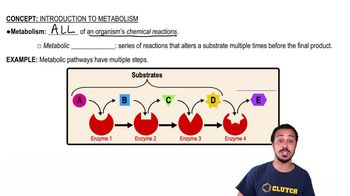
Metabolic Pathways

Metabolic pathways are series of chemical reactions occurring within a cell, where substrates are converted into products through the action of enzymes. Each step in the pathway is catalyzed by a specific enzyme, which facilitates the transformation of substrates into products. Understanding these pathways is crucial for analyzing how organisms metabolize nutrients and produce energy.
Recommended video:
Guided course
02:17
Introduction to Metabolism

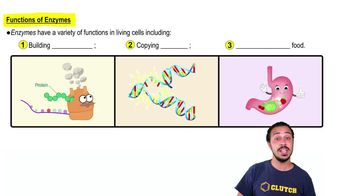
Enzyme Function and Mutations

Enzymes are biological catalysts that speed up chemical reactions by lowering the activation energy required. A mutation in an enzyme can impair its function, affecting the metabolic pathway it is part of. In the context of the question, identifying which enzyme is affected by the mutation helps determine the specific step in the pathway that is disrupted, leading to the observed growth conditions of the mutant strain.
Recommended video:
Guided course
02:32
Functions of Enzymes

Substrate Specificity

Substrate specificity refers to the ability of an enzyme to selectively catalyze a reaction for a particular substrate or group of substrates. In metabolic pathways, each enzyme typically acts on specific substrates, and changes in substrate availability can influence the pathway's overall function. In this scenario, the inability of the mutant strain to utilize substrates 1-4 while being able to grow with substrate 5 indicates a specific disruption in the pathway's earlier steps.
Recommended video:
Guided course
10:55
Receptor Specificity
Related Practice
Textbook Question

Explain what's wrong with this statement: All point mutations change the genotype and the phenotype.

907
views
Textbook Question
Explain what's wrong with this statement: All point mutations change the genotype and the phenotype.
891
views
Textbook Question
Draw a hypothetical metabolic pathway in Neurospora crassa composed of five substrates, five enzymes, and a product called nirvana. Number the substrates 1–5, and label the enzymes A–E, in order. (For instance, enzyme A catalyzes the reaction between substrates 1 and 2.) (a) Suppose a mutation made the gene for enzyme C nonfunctional. What molecule would accumulate in the affected cells?
1378
views
Textbook Question

Draw a hypothetical metabolic pathway in Neurospora crassa composed of five substrates, five enzymes, and a product called nirvana. Number the substrates 1–5, and label the enzymes A–E, in order. (For instance, enzyme A catalyzes the reaction between substrates 1 and 2.)

(a) Suppose a mutation made the gene for enzyme C nonfunctional. What molecule would accumulate in the affected cells?

859
views
Textbook Question

Draw a hypothetical metabolic pathway in Neurospora crassa composed of five substrates, five enzymes, and a product called nirvana. Number the substrates 1–5, and label the enzymes A–E, in order. (For instance, enzyme A catalyzes the reaction between substrates 1 and 2.)

(b) Suppose a mutant strain can survive if substrate 5 is added to the growth medium, but it cannot grow if substrates 1, 2, 3, or 4 are added. Which enzyme in the pathway is affected in this mutant?

894
views
Textbook Question

One of the possibilities considered about the genetic code was that the code was overlapping, meaning that a single base could be part of up to three codons. How many amino acids would be encoded in the sequence 5′-AUGUUACGGAAU-3′ by a non-overlapping and a maximally overlapping triplet code?

a. 4 (non-overlapping) and 16 (overlapping)

b. 4 and 12

c. 4 and 10

d. 12 and 4

1551
views