Pearson+ LogoPearson+ Logo
Ch. 16 - How Genes Work
Freeman - Biological Science 7th Edition
Freeman7th EditionBiological ScienceISBN: 9783584863285Not the one you use?Change textbook
Chapter 16, Problem 9b

Draw a hypothetical metabolic pathway in Neurospora crassa composed of five substrates, five enzymes, and a product called nirvana. Number the substrates 1–5, and label the enzymes A–E, in order. (For instance, enzyme A catalyzes the reaction between substrates 1 and 2.)
(b) Suppose a mutant strain can survive if substrate 5 is added to the growth medium, but it cannot grow if substrates 1, 2, 3, or 4 are added. Which enzyme in the pathway is affected in this mutant?

Verified step by step guidance
1
Begin by understanding the concept of a metabolic pathway. A metabolic pathway is a series of chemical reactions occurring within a cell, where each step is facilitated by a specific enzyme. In this problem, you need to create a pathway with five substrates and five enzymes leading to a final product called nirvana.
Draw the pathway: Start with substrate 1, which is converted to substrate 2 by enzyme A. Then, substrate 2 is converted to substrate 3 by enzyme B. Continue this pattern, where substrate 3 is converted to substrate 4 by enzyme C, substrate 4 is converted to substrate 5 by enzyme D, and finally, substrate 5 is converted to the product nirvana by enzyme E.
Label each part of the pathway: Assign numbers to the substrates (1 to 5) and letters to the enzymes (A to E). Ensure that enzyme A catalyzes the reaction between substrates 1 and 2, enzyme B between substrates 2 and 3, and so on, until enzyme E catalyzes the conversion of substrate 5 to nirvana.
Analyze the mutant strain scenario: The mutant strain can survive only if substrate 5 is added, indicating that the conversion from substrate 4 to substrate 5 is not occurring naturally. This suggests that enzyme D, which catalyzes the conversion of substrate 4 to substrate 5, is affected in the mutant strain.
Conclude the analysis: Since the mutant strain cannot grow with substrates 1, 2, 3, or 4, but can grow with substrate 5, enzyme D is likely non-functional or absent in the mutant strain, preventing the conversion of substrate 4 to substrate 5.

Verified video answer for a similar problem:

This video solution was recommended by our tutors as helpful for the problem above.
Video duration:
2m
Was this helpful?

Key Concepts

Here are the essential concepts you must grasp in order to answer the question correctly.

Metabolic Pathway

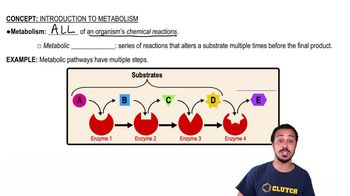
A metabolic pathway is a series of chemical reactions occurring within a cell, where each step is facilitated by a specific enzyme. These pathways convert substrates through intermediate steps into a final product, playing a crucial role in maintaining cellular functions and energy production.
Recommended video:
Guided course
02:17
Introduction to Metabolism

Enzyme Function

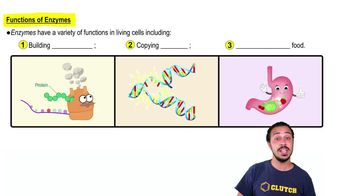
Enzymes are biological catalysts that speed up chemical reactions in metabolic pathways without being consumed. Each enzyme is specific to a particular reaction, facilitating the conversion of substrates into products. In the context of the question, enzymes A-E catalyze sequential reactions between substrates 1-5 to produce the final product, nirvana.
Recommended video:
Guided course
02:32
Functions of Enzymes

Mutant Strain Analysis

Analyzing mutant strains involves understanding how genetic mutations affect metabolic pathways. In the given scenario, the mutant strain's inability to grow with substrates 1-4 suggests a disruption in the pathway before substrate 5. This indicates that the enzyme responsible for converting substrate 4 to 5 is likely defective, preventing the completion of the pathway.
Recommended video:
Guided course
08:56
The Griffith Experiment
Related Practice
Textbook Question
Draw a hypothetical metabolic pathway in Neurospora crassa composed of five substrates, five enzymes, and a product called nirvana. Number the substrates 1–5, and label the enzymes A–E, in order. (For instance, enzyme A catalyzes the reaction between substrates 1 and 2.) (a) Suppose a mutation made the gene for enzyme C nonfunctional. What molecule would accumulate in the affected cells?
1378
views
Textbook Question
Draw a hypothetical metabolic pathway in Neurospora crassa composed of five substrates, five enzymes, and a product called nirvana. Number the substrates 1–5, and label the enzymes A–E, in order. (For instance, enzyme A catalyzes the reaction between substrates 1 and 2.) (b) Suppose a mutant strain can survive if substrate 5 is added to the growth medium, but it cannot grow if substrates 1, 2, 3, or 4 are added. Which enzyme in the pathway is affected in this mutant?
1553
views
Textbook Question

Draw a hypothetical metabolic pathway in Neurospora crassa composed of five substrates, five enzymes, and a product called nirvana. Number the substrates 1–5, and label the enzymes A–E, in order. (For instance, enzyme A catalyzes the reaction between substrates 1 and 2.)

(a) Suppose a mutation made the gene for enzyme C nonfunctional. What molecule would accumulate in the affected cells?

859
views
Textbook Question

One of the possibilities considered about the genetic code was that the code was overlapping, meaning that a single base could be part of up to three codons. How many amino acids would be encoded in the sequence 5′-AUGUUACGGAAU-3′ by a non-overlapping and a maximally overlapping triplet code?

a. 4 (non-overlapping) and 16 (overlapping)

b. 4 and 12

c. 4 and 10

d. 12 and 4

1551
views
Textbook Question
One of the possibilities considered about the genetic code was that the code was overlapping, meaning that a single base could be part of up to three codons. How many amino acids would be encoded in the sequence 5′-AUGUUACGGAAU-3′ by a non-overlapping and a maximally overlapping triplet code?a. 4 (non-overlapping) and 16 (overlapping)b. 4 and 12c. 4 and 10d. 12 and 4
1915
views
Textbook Question
Controlling the rates of transcription and translation is important in bacteria to avoid collisions between ribosomes and RNA polymerases. Calculate what the maximum rate of translation by a ribosome in a bacterial cell would have to be, in units of amino acids per second, so as not to overtake an RNA polymerase that is synthesizing mRNA at a rate of 60 nucleotides per second. How long would it take for this bacterial cell to translate an mRNA containing 1800 codons?
1746
views