
Pearson+ LogoPearson+ Logo
Ch. 16 - How Genes Work
Freeman - Biological Science 7th Edition
Freeman7th EditionBiological ScienceISBN: 9783584863285Not the one you use?Change textbook
Chapter 16, Problem 9

Draw a hypothetical metabolic pathway in Neurospora crassa composed of five substrates, five enzymes, and a product called nirvana. Number the substrates 1–5, and label the enzymes A–E, in order. (For instance, enzyme A catalyzes the reaction between substrates 1 and 2.) (a) Suppose a mutation made the gene for enzyme C nonfunctional. What molecule would accumulate in the affected cells?

Verified step by step guidance
1
Identify the sequence of substrates and enzymes in the metabolic pathway. Since the pathway consists of five substrates (1-5) and five enzymes (A-E), arrange them in a sequential order where each enzyme catalyzes the reaction between consecutive substrates.
Visualize the pathway: Substrate 1 is converted by enzyme A to Substrate 2, Substrate 2 is converted by enzyme B to Substrate 3, Substrate 3 is converted by enzyme C to Substrate 4, Substrate 4 is converted by enzyme D to Substrate 5, and finally, Substrate 5 is converted by enzyme E to the product nirvana.
Understand the effect of the mutation on enzyme C: If enzyme C is nonfunctional due to a mutation, it cannot catalyze the conversion of Substrate 3 to Substrate 4.
Determine the accumulation: Since enzyme C is nonfunctional, Substrate 3 cannot be converted to Substrate 4 and will accumulate in the cells.
Consider the downstream effects: The accumulation of Substrate 3 might also affect the levels of Substrates 4 and 5, and the final product nirvana, as these subsequent reactions depend on the product of the reaction catalyzed by enzyme C.

Verified video answer for a similar problem:

This video solution was recommended by our tutors as helpful for the problem above.
Video duration:
2m
Was this helpful?

Key Concepts

Here are the essential concepts you must grasp in order to answer the question correctly.

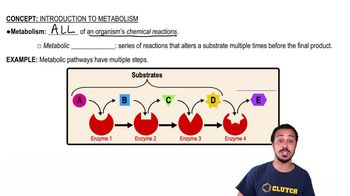
Metabolic Pathways

Metabolic pathways are series of chemical reactions occurring within a cell, where substrates are converted into products through the action of enzymes. Each step in the pathway is catalyzed by a specific enzyme, which facilitates the transformation of substrates into products. Understanding these pathways is crucial for analyzing how mutations can affect metabolic processes and lead to the accumulation of specific molecules.
Recommended video:
Guided course
02:17
Introduction to Metabolism

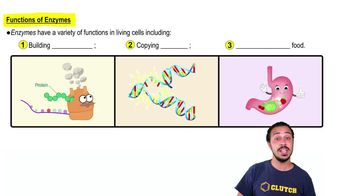
Enzymes and Their Function

Enzymes are biological catalysts that speed up chemical reactions in metabolic pathways by lowering the activation energy required for the reaction to occur. Each enzyme is specific to its substrate and plays a critical role in determining the flow of metabolites through the pathway. A mutation that renders an enzyme nonfunctional can halt the pathway at that point, leading to the accumulation of substrates preceding the affected enzyme.
Recommended video:
Guided course
02:32
Functions of Enzymes

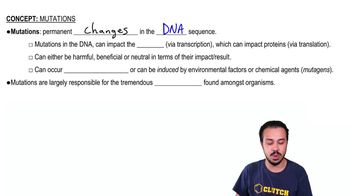
Effects of Mutations on Metabolism

Mutations in genes encoding enzymes can disrupt normal metabolic functions, leading to the accumulation of specific substrates. In the context of Neurospora crassa, if enzyme C is nonfunctional due to a mutation, the substrates that precede enzyme C in the pathway will not be converted into the next product. This results in the buildup of the substrate immediately before enzyme C, which is essential for predicting the metabolic consequences of such mutations.
Recommended video:
Related Practice
Textbook Question
In a particular bacterial species, temperature-sensitive conditional mutations cause expression of a wild-type phenotype at one growth temperature and a mutant phenotype at another—typically higher—temperature. Imagine that when a bacterial cell carrying such a mutation is shifted from low to high growth temperatures, RNA polymerases in the process of elongation complete transcription normally, but no new transcripts can be started. The mutation in this strain most likely affects:a. the terminator sequenceb. the start codonc. sigmad. one of the polypeptides of the core RNA polymerase
1460
views
Textbook Question

Explain what's wrong with this statement: All point mutations change the genotype and the phenotype.

907
views
Textbook Question
Explain what's wrong with this statement: All point mutations change the genotype and the phenotype.
891
views
Textbook Question
Draw a hypothetical metabolic pathway in Neurospora crassa composed of five substrates, five enzymes, and a product called nirvana. Number the substrates 1–5, and label the enzymes A–E, in order. (For instance, enzyme A catalyzes the reaction between substrates 1 and 2.) (b) Suppose a mutant strain can survive if substrate 5 is added to the growth medium, but it cannot grow if substrates 1, 2, 3, or 4 are added. Which enzyme in the pathway is affected in this mutant?
1553
views
Textbook Question

Draw a hypothetical metabolic pathway in Neurospora crassa composed of five substrates, five enzymes, and a product called nirvana. Number the substrates 1–5, and label the enzymes A–E, in order. (For instance, enzyme A catalyzes the reaction between substrates 1 and 2.)

(a) Suppose a mutation made the gene for enzyme C nonfunctional. What molecule would accumulate in the affected cells?

859
views
Textbook Question

Draw a hypothetical metabolic pathway in Neurospora crassa composed of five substrates, five enzymes, and a product called nirvana. Number the substrates 1–5, and label the enzymes A–E, in order. (For instance, enzyme A catalyzes the reaction between substrates 1 and 2.)

(b) Suppose a mutant strain can survive if substrate 5 is added to the growth medium, but it cannot grow if substrates 1, 2, 3, or 4 are added. Which enzyme in the pathway is affected in this mutant?

894
views