Pearson+ LogoPearson+ Logo
Ch. 20 - The Molecular Revolution: Biotechnology, Genomics, and New Frontiers
Freeman - Biological Science 7th Edition
Freeman7th EditionBiological ScienceISBN: 9783584863285Not the one you use?Change textbook
Chapter 20, Problem 1

What do restriction endonucleases do?

Verified step by step guidance
1
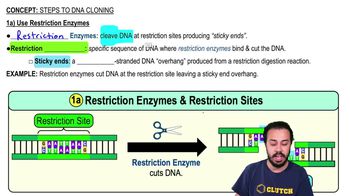
Understand that restriction endonucleases, also known as restriction enzymes, are proteins used by bacteria to defend against viral infections.
Learn that these enzymes recognize specific, short nucleotide sequences in the DNA called recognition sites and bind to these sequences.
Recognize that once bound, restriction endonucleases cleave the DNA at or near these recognition sites, cutting the DNA into fragments.
Explore the concept that the specific cutting action of restriction endonucleases is used in molecular biology for various applications, such as genetic engineering, cloning, and DNA fingerprinting.
Note that the fragments generated by restriction endonucleases can be separated by size using gel electrophoresis, allowing scientists to analyze the genetic material.

Verified video answer for a similar problem:

This video solution was recommended by our tutors as helpful for the problem above.
Video duration:
2m
Was this helpful?

Key Concepts

Here are the essential concepts you must grasp in order to answer the question correctly.

Restriction Endonucleases

Restriction endonucleases, also known as restriction enzymes, are proteins that recognize specific sequences of nucleotides in DNA and cleave the DNA at or near these sites. They are essential tools in molecular biology for manipulating DNA, allowing scientists to cut and paste genetic material for cloning, sequencing, and analysis.
Recommended video:
Guided course
03:27
1a) Use Restriction Enzymes

DNA Recognition Sites

Each restriction endonuclease has a unique recognition site, typically a palindromic sequence of 4 to 8 base pairs. This specificity allows the enzyme to target and cut DNA at precise locations, which is crucial for applications such as genetic engineering and recombinant DNA technology.
Recommended video:
Guided course
06:16
Ribosomal tRNA Binding Sites

Applications in Biotechnology

Restriction endonucleases are widely used in biotechnology for various applications, including gene cloning, DNA fingerprinting, and the creation of genetically modified organisms (GMOs). By enabling the precise manipulation of DNA, these enzymes have revolutionized genetic research and biopharmaceutical development.
Recommended video:
Guided course
03:07
Review & Application of DNA Cloning in Medicine