Ch. 3 - Derivatives
Briggs - Calculus: Early Transcendentals 3rd Edition
Briggs3rd EditionCalculus: Early TranscendentalsISBN: 9780136847243Not the one you use?Change textbook
Chapter 3, Problem 3.10.7c

Derivatives of inverse functions from a table Use the following tables to determine the indicated derivatives or state that the derivative cannot be determined. <IMAGE>
c. (f^-1)'(1)

Verified step by step guidance
1
Identify the relationship between a function and its inverse. If \( y = f(x) \), then \( x = f^{-1}(y) \). The derivative of the inverse function \( (f^{-1})'(y) \) can be found using the formula \( (f^{-1})'(y) = \frac{1}{f'(x)} \) where \( x = f^{-1}(y) \).
From the problem, we need to find \( (f^{-1})'(1) \). This means we need to find the value of \( x \) such that \( f(x) = 1 \).
Look at the table provided in the problem to find the value of \( x \) for which \( f(x) = 1 \). This will give us the point \( (x, 1) \) on the graph of \( f \).
Once the correct \( x \) is identified, use the table to find \( f'(x) \), the derivative of \( f \) at this \( x \).
Finally, apply the formula \( (f^{-1})'(1) = \frac{1}{f'(x)} \) using the value of \( f'(x) \) obtained from the table to find the derivative of the inverse function at the given point.

Verified video answer for a similar problem:

This video solution was recommended by our tutors as helpful for the problem above.
Video duration:
3m
Was this helpful?

Key Concepts

Here are the essential concepts you must grasp in order to answer the question correctly.

Inverse Functions

Inverse functions are functions that 'reverse' the effect of the original function. If f(x) takes an input x and produces an output y, then the inverse function f^-1(y) takes y back to x. Understanding how to find and work with inverse functions is crucial for determining their derivatives.
Recommended video:
4:49
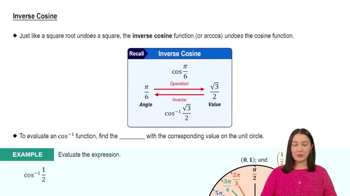
Inverse Cosine

Derivative of Inverse Functions

The derivative of an inverse function can be calculated using the formula (f^-1)'(y) = 1 / f'(x), where y = f(x). This relationship shows that the derivative of the inverse function at a point is the reciprocal of the derivative of the original function at the corresponding point. This concept is essential for solving problems involving derivatives of inverse functions.
Recommended video:
07:26
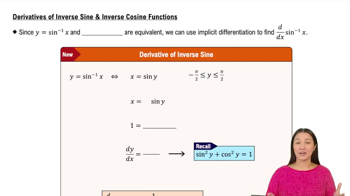
Derivatives of Inverse Sine & Inverse Cosine

Using Tables for Derivatives

When working with derivatives from tables, it is important to locate the necessary values for the function and its derivative. The table typically provides values of f(x) and f'(x) at specific points, which can be used to find the derivative of the inverse function. Understanding how to interpret and extract information from these tables is key to solving derivative problems.
Recommended video:
05:44
Derivatives
Related Practice
Textbook Question

{Use of Tech} Power and energy Power and energy are often used interchangeably, but they are quite different. Energy is what makes matter move or heat up. It is measured in units of joules or Calories, where 1 Cal=4184 J. One hour of walking consumes roughly 10⁶J, or 240 Cal. On the other hand, power is the rate at which energy is used, which is measured in watts, where 1 W=1 J/s. Other useful units of power are kilowatts (1 kW=10³ W) and megawatts (1 MW=10⁶ W). If energy is used at a rate of 1 kW for one hour, the total amount of energy used is 1 kilowatt-hour (1 kWh=3.6×10⁶ J) Suppose the cumulative energy used in a large building over a 24-hr period is given by E(t)=100t+4t²−t³ / 9kWh where t=0 corresponds to midnight.

c. Graph the power function and interpret the graph. What are the units of power in this case?

215
views
Textbook Question

62–65. {Use of Tech} Graphing f and f'

c. Verify that the zeros of f' correspond to points at which f has a horizontal tangent line.

f(x)=(sec^−1 x)/x on [1,∞)

219
views
Textbook Question

Derivatives of sin^n x Calculate the following derivatives using the Product Rule.

c. d/dx (sin⁴ x)

299
views
Textbook Question

Derivatives using tables Let h(x)=f(g(x))h(x)=f(g(x)) and p(x)=g(f(x))p(x)=g(f(x)). Use the table to compute the following derivatives.

<IMAGE>

c. p(4)p^{\(\prime\)}\(\left\)(4\(\right\))

279
views
Textbook Question

Throwing a stone Suppose a stone is thrown vertically upward from the edge of a cliff on Earth with an initial velocity of 32 ft/s from a height of 48 ft above the ground. The height (in feet) of the stone above the ground t seconds after it is thrown is s(t) = -16t²+32t+48.

c. What is the height of the stone at the highest point?

234
views
Textbook Question

Computing the derivative of f(x) = e^-x

c. Use parts (a) and (b) to find the derivative of f(x) = e^-x.

255
views