Back
Back
Problem 7.1.72
Derivative of ln|x| Differentiate ln x, for x > 0, and differentiate ln(−x), for x < 0, to conclude that d/dx (ln|x|) = 1/x
Problem 7.3.7
A calculator has a built-in sinh⁻¹ x function, but no csch⁻¹ x function. How do you evaluate csch⁻¹ 5 on such a calculator?
Problem 7.1.25
Evaluate the following derivatives.
d/dx ((1/x)ˣ)
Problem 7.1.54
29–62. Integrals Evaluate the following integrals. Include absolute values only when needed.
∫₀^{π} 2^{sin x} · cos x dx
Problem 7.2.25
Population of Texas Texas was the third fastest growing state in the United States in 2016. Texas grew from 25.1 million in 2010 to 26.47 million in 2016. Use an exponential growth model to predict the population of Texas in 2025.
Problem 7.3.105
Inverse identity Show that cosh⁻¹(cosh x) = |x| by using the formula cosh⁻¹ t = ln (t + √(t² – 1)) and considering the cases x ≥ 0 and x < 0.
Problem 7.2.29
27–30. Designing exponential decay functions Devise an exponential decay function that fits the following data; then answer the accompanying questions. Be sure to identify the reference point (t = 0) and units of time.
Valium metabolism The drug Valium is eliminated from the bloodstream with a half-life of 36 hr. Suppose a patient receives an initial dose of 20 mg of Valium at midnight. How much Valium is in the patient’s blood at noon the next day? When will the Valium concentration reach 10% of its initial level?
Problem 7.1.64
63–66. Calculator limits Use a calculator to make a table similar to Table 7.1 to approximate the following limits. Confirm your result with l’Hôpital’s Rule.
limₕ→₀ (1 + 3h)^{2/h}
Problem 7.3.91
88–91. Limits Use l’Hôpital’s Rule to evaluate the following limits.
lim x → 0⁺ (tanh x)ˣ
Problem 7.2.18
15–20. Designing exponential growth functions Complete the following steps for the given situation.
a. Find the rate constant k and use it to devise an exponential growth function that fits the given data.
b. Answer the accompanying question.
Savings account An initial deposit of $1500 is placed in a savings account with an APY of 3.1%. How long will it take until the balance of the account is $2500? Assume the interest rate remains constant and no additional deposits or withdrawals are made.
Problem 7.3.29
22–36. Derivatives Find the derivatives of the following functions.
f(x) = x² cosh² 3x
Problem 7.1.68
Logarithm properties Use the integral definition of the natural logarithm to prove that ln(x/y) = ln x - ln y.
Problem 7.3.67
63–68. Definite integrals Evaluate the following definite integrals. Use Theorem 7.7 to express your answer in terms of logarithms.
∫₁/₈¹ dx/x√(1 + x²/³)
Problem 7.1.57
29–62. Integrals Evaluate the following integrals. Include absolute values only when needed.
∫₁ᵉ^² (ln x)^5 / x dx
Problem 7.3.88
88–91. Limits Use l’Hôpital’s Rule to evaluate the following limits.
lim x → ∞ (1 − coth x) / (1 − tanh x)
Problem 7.1.33
29–62. Integrals Evaluate the following integrals. Include absolute values only when needed.
∫ e^{2x} / (4 + e^{2x}) dx
Problem 7.3.5
Express sinh⁻¹ x in terms of logarithms.
Problem 7.1.10
7–28. Derivatives Evaluate the following derivatives.
d/dx (ln (cos² x))
Problem 7.2.48
Rule of 70 Bankers use the Rule of 70, which says that if an account increases at a fixed rate of p%/yr, its doubling time is approximately 70/p. Use linear approximation to explain why and when this is true.
Problem 7.53
37–56. Integrals Evaluate each integral.
∫ (cosh z) / (sinh² z) dz
Problem 7.1.30
29–62. Integrals Evaluate the following integrals. Include absolute values only when needed.
∫ (x²) / (4x³ + 7) dx
Problem 7.2.20
15–20. Designing exponential growth functions Complete the following steps for the given situation.
a. Find the rate constant k and use it to devise an exponential growth function that fits the given data.
b. Answer the accompanying question.
Cell growth The number of cells in a tumor doubles every 6 weeks starting with 8 cells. After how many weeks does the tumor have 1500 cells?
Problem 7.3.100
Surface area of a catenoid When the catenary y = a cosh x/a is revolved about the x-axis, it sweeps out a surface of revolution called a catenoid. Find the area of the surface generated when y = cosh x on [–ln 2, ln 2] is rotated about the x-axis.
Problem 7.3.72
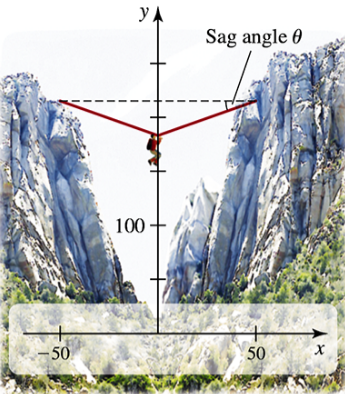
Sag angle Imagine a climber clipping onto the rope described in Example 7 and pulling himself to the rope’s midpoint. Because the rope is supporting the weight of the climber, it no longer takes the shape of the catenary y = 200 cosh x/200. Instead, the rope (nearly) forms two sides of an isosceles triangle. Compute the sag angle θ illustrated in the figure, assuming the rope does not stretch when weighted. Recall from Example 7 that the length of the rope is 101 ft.
Problem 7.3.69
Catenary arch The portion of the curve y =17/15 - cosh x that lies above the x-axis forms a catenary arch. Find the average height of the arch above the x-axis.
Problem 7.3.12
11–15. Identities Prove each identity using the definitions of the hyperbolic functions.
tanh(−x) = −tanh x
Problem 7.3.37
37–56. Integrals Evaluate each integral.
∫ cosh 2x dx
Problem 7.3.76
Tsunamis A tsunami is an ocean wave often caused by earthquakes on the ocean floor; these waves typically have long wavelengths, ranging from 150 to 1000 km. Imagine a tsunami traveling across the Pacific Ocean, which is the deepest ocean in the world, with an average depth of about 4000 m. Explain why the shallow-water velocity equation (Exercise 75) applies to tsunamis even though the actual depth of the water is large. What does the shallow-water equation say about the speed of a tsunami in the Pacific Ocean (use d = 4000 m)?
Problem 7.1.78
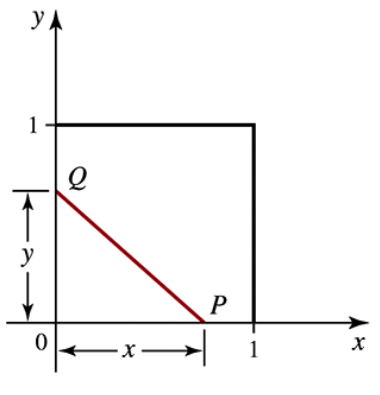
Probability as an integral Two points P and Q are chosen randomly, one on each of two adjacent sides of a unit square (see figure). What is the probability that the area of the triangle formed by the sides of the square and the line segment PQ is less than one-fourth the area of the square? Begin by showing that x and y must satisfy xy < 1/2 in order for the area condition to be met. Then argue that the required probability is: 1/2 + ∫[1/2 to 1] (dx / 2x) and evaluate the integral.
Problem 7.3.50
37–56. Integrals Evaluate each integral.
∫ dx/x√(16 + x²)