Ch. 2 - Limits
Briggs - Calculus: Early Transcendentals 3rd Edition
Briggs3rd EditionCalculus: Early TranscendentalsISBN: 9780136847243Not the one you use?Change textbook
Chapter 2, Problem 14a

The position of an object moving vertically along a line is given by the function s(t)=4.9t2+30t+20s\(\left\)(t\(\right\))=-4.9t^2+30t+20. Find the average velocity of the object over the following intervals.
[0,3]\(\left\[\lbrack\)0,3\(\right\]\rbrack\)

Verified step by step guidance
1
To find the average velocity of the object over the interval [0, 3], we need to use the formula for average velocity: \( v_{avg} = \frac{s(t_2) - s(t_1)}{t_2 - t_1} \), where \( t_1 = 0 \) and \( t_2 = 3 \).
First, calculate \( s(t_1) = s(0) \) by substituting \( t = 0 \) into the position function \( s(t) = -4.9t^2 + 30t + 20 \). This will give us the initial position of the object.
Next, calculate \( s(t_2) = s(3) \) by substituting \( t = 3 \) into the position function. This will give us the position of the object at \( t = 3 \).
Subtract \( s(0) \) from \( s(3) \) to find the change in position, \( \Delta s = s(3) - s(0) \).
Finally, divide \( \Delta s \) by the change in time, \( \Delta t = 3 - 0 \), to find the average velocity: \( v_{avg} = \frac{\Delta s}{\Delta t} \).

Verified video answer for a similar problem:

This video solution was recommended by our tutors as helpful for the problem above.
Video duration:
3m
Was this helpful?

Key Concepts

Here are the essential concepts you must grasp in order to answer the question correctly.

Position Function

The position function describes the location of an object at any given time. In this case, the function s(t) = -4.9t² + 30t + 20 represents the vertical position of an object in motion, where 't' is time in seconds. Understanding this function is crucial for analyzing the object's movement and calculating other related quantities like velocity.
Recommended video:
5:20
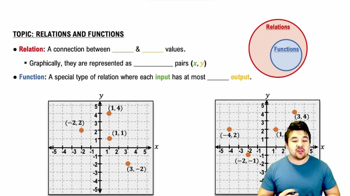
Relations and Functions

Average Velocity

Average velocity is defined as the change in position divided by the change in time over a specified interval. Mathematically, it is calculated as (s(b) - s(a)) / (b - a), where [a, b] is the interval of interest. This concept is essential for determining how fast the object is moving on average during the given time period.
Recommended video:
06:37
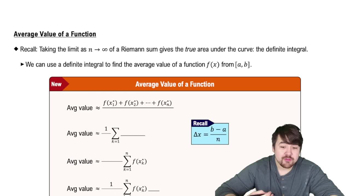
Average Value of a Function

Interval Notation

Interval notation is a mathematical notation used to represent a range of values. The notation [0, 3] indicates that the interval includes both endpoints, meaning time 't' can take any value from 0 to 3 seconds, inclusive. Understanding interval notation is important for correctly interpreting the time frame over which the average velocity is calculated.
Recommended video:
04:22
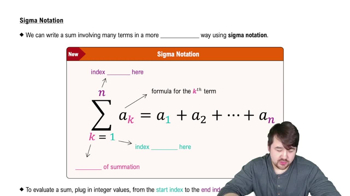
Sigma Notation
Related Practice
Textbook Question

Suppose g(x) = {2x+1 if x≠0

5 if x=0.


Compute g(0) and lim x→0 g(x)

359
views

Textbook Question

The position of an object moving vertically along a line is given by the function s(t)=16t2+128ts\(\left\)(t\(\right\))=-16t^2+128t. Find the average velocity of the object over the following intervals.

[1,4]\(\left\[\lbrack\)1,4\(\right\]\rbrack\)

378
views
Textbook Question

Determine the following limits.

lim x→a (3x + 1)^2 − (3a + 1)^2 / x − a, where a is constant

348
views
Textbook Question

Let g(x)=x34x8x2g\(\left\)(x\(\right\))=\(\frac{x^3-4x}{8\left|x-2\right|}\). <IMAGE>

Make a conjecture about the values of limx2g(x){\(\displaystyle\]\lim\)_{x\(\to\)2^{-}}g\(\left\)(x\(\right\))}, limx2+g(x){\(\displaystyle\]\lim\)_{x\(\to\)2^{+}}g\(\left\)(x\(\right\))}, and limx2g(x){\(\displaystyle\]\lim\)_{x\(\to\)2}g\(\left\)(x\(\right\))} or state that they do not exist.

358
views
Textbook Question

The position of an object moving vertically along a line is given by the function s(t)=4.9t2+30t+20s\(\left\)(t\(\right\))=-4.9t^2+30t+20. Find the average velocity of the object over the following intervals.

[0,h]\(\left\[\lbrack\)0,h\(\right\]\rbrack\), where h>0h\(\gt{0}\) is a real number

415
views
Textbook Question

The position of an object moving vertically along a line is given by the function s(t)=16t2+128ts\(\left\)(t\(\right\))=-16t^2+128t. Find the average velocity of the object over the following intervals.

[1,2]\(\left\[\lbrack\)1,2\(\right\]\rbrack\)

397
views