

Ch. 4 - Applications of the Derivative
Briggs - Calculus: Early Transcendentals 3rd Edition
Briggs3rd EditionCalculus: Early TranscendentalsISBN: 9780136847243Not the one you use?Change textbook
Chapter 4, Problem 4.6.37

Use linear approximations to estimate the following quantities. Choose a value of a to produce a small error.
1/203

Verified step by step guidance
1
Identify the function you want to approximate. In this case, we are approximating f(x) = 1/x at x = 203.
Choose a value of 'a' close to 203 where the function is easy to compute. A good choice is a = 200, since 1/200 is straightforward to calculate.
Find the derivative of the function f(x) = 1/x. The derivative is f'(x) = -1/x^2.
Use the linear approximation formula: L(x) = f(a) + f'(a)(x - a). Substitute a = 200 into the formula.
Calculate L(203) using the values from the previous steps: L(203) = 1/200 + (-1/200^2)(203 - 200). This will give you the linear approximation of 1/203.

Verified video answer for a similar problem:

This video solution was recommended by our tutors as helpful for the problem above.
Video duration:
4m
Was this helpful?

Key Concepts

Here are the essential concepts you must grasp in order to answer the question correctly.

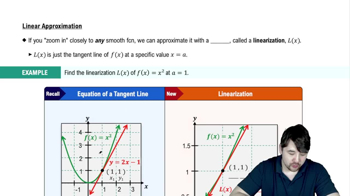
Linear Approximation

Linear approximation is a method used to estimate the value of a function near a given point using the tangent line at that point. It is based on the idea that a function can be closely approximated by a linear function when the input is near a specific value. The formula for linear approximation is f(a) + f'(a)(x - a), where f'(a) is the derivative at point a.
Recommended video:
07:17
Linearization

Derivatives

The derivative of a function at a point measures the rate at which the function's value changes as its input changes. It is a fundamental concept in calculus that provides information about the slope of the tangent line to the function at that point. Understanding derivatives is crucial for applying linear approximation, as they are used to determine the slope of the tangent line.
Recommended video:
05:44
Derivatives

Choosing a Value for a

Selecting an appropriate value for 'a' in linear approximation is essential for minimizing error in the estimate. Ideally, 'a' should be a value close to the point of interest (in this case, 203) where the function is easy to evaluate. A well-chosen 'a' leads to a more accurate linear approximation, as the tangent line will closely follow the curve of the function near that point.
Recommended video:
06:37
Average Value of a Function