

Ch. 3 - Derivatives
Briggs - Calculus: Early Transcendentals 3rd Edition
Briggs3rd EditionCalculus: Early TranscendentalsISBN: 9780136847243Not the one you use?Change textbook
Chapter 3, Problem 3.9.88

Find the following higher-order derivatives.


d²/dx² (In(x² + 1))

Verified step by step guidance
1
Step 1: Identify the function for which we need to find the second derivative. The function is \( f(x) = \ln(x^2 + 1) \).
Step 2: Find the first derivative of \( f(x) \). Use the chain rule: \( \frac{d}{dx}[\ln(u)] = \frac{1}{u} \cdot \frac{du}{dx} \), where \( u = x^2 + 1 \). Thus, \( \frac{d}{dx}[\ln(x^2 + 1)] = \frac{1}{x^2 + 1} \cdot \frac{d}{dx}[x^2 + 1] \).
Step 3: Differentiate \( x^2 + 1 \) with respect to \( x \). The derivative is \( \frac{d}{dx}[x^2 + 1] = 2x \). Substitute this back into the expression from Step 2 to get the first derivative: \( \frac{d}{dx}[\ln(x^2 + 1)] = \frac{2x}{x^2 + 1} \).
Step 4: Find the second derivative by differentiating the first derivative \( \frac{2x}{x^2 + 1} \) with respect to \( x \). Use the quotient rule: \( \frac{d}{dx}[\frac{v}{w}] = \frac{w \cdot \frac{dv}{dx} - v \cdot \frac{dw}{dx}}{w^2} \), where \( v = 2x \) and \( w = x^2 + 1 \).
Step 5: Calculate \( \frac{dv}{dx} = 2 \) and \( \frac{dw}{dx} = 2x \). Substitute these into the quotient rule formula to find the second derivative: \( \frac{d^2}{dx^2}[\ln(x^2 + 1)] = \frac{(x^2 + 1) \cdot 2 - 2x \cdot 2x}{(x^2 + 1)^2} \). Simplify the expression to complete the calculation.

Verified video answer for a similar problem:

This video solution was recommended by our tutors as helpful for the problem above.
Video duration:
6m
Was this helpful?

Key Concepts

Here are the essential concepts you must grasp in order to answer the question correctly.

Higher-Order Derivatives

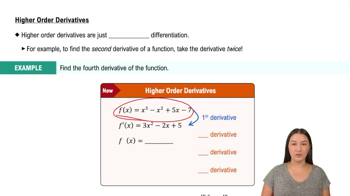
Higher-order derivatives refer to the derivatives of a function taken multiple times. The first derivative gives the rate of change of the function, the second derivative provides information about the curvature or concavity, and so on. In this context, finding the second derivative involves differentiating the function twice with respect to the variable.
Recommended video:
02:42
Higher Order Derivatives

Chain Rule

The chain rule is a fundamental differentiation technique used when differentiating composite functions. It states that the derivative of a composite function is the derivative of the outer function evaluated at the inner function, multiplied by the derivative of the inner function. This rule is essential for correctly differentiating functions like In(x² + 1), where x² + 1 is the inner function.
Recommended video:
05:02
Intro to the Chain Rule

Natural Logarithm Function

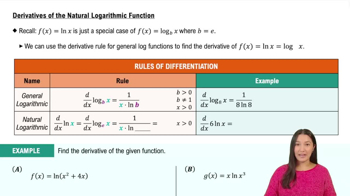
The natural logarithm function, denoted as In(x), is the logarithm to the base e, where e is approximately 2.71828. It is important in calculus because it has unique properties, such as its derivative being 1/x. Understanding how to differentiate the natural logarithm, especially in the context of composite functions, is crucial for solving the given problem.
Recommended video:
05:18
Derivative of the Natural Logarithmic Function