
Ch. 4 - Applications of the Derivative
Briggs - Calculus: Early Transcendentals 3rd Edition
Briggs3rd EditionCalculus: Early TranscendentalsISBN: 9780136847243Not the one you use?Change textbook
Chapter 4, Problem 4.6.53c

Explain why or why not Determine whether the following statements are true and give an explanation or counterexample.


c. If f(x) = mx + b, then the linear approximation to f at any point is L(x) = f(x).

Verified step by step guidance
1
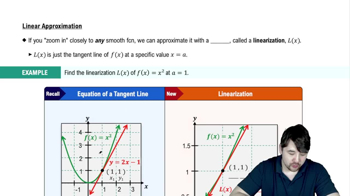
First, understand the concept of linear approximation. Linear approximation is a method used to approximate the value of a function near a given point using the tangent line at that point.
For a function f(x), the linear approximation at a point x = a is given by the formula L(x) = f(a) + f'(a)(x - a), where f'(a) is the derivative of f at x = a.
Consider the function f(x) = mx + b, which is a linear function. The derivative of f(x) with respect to x is f'(x) = m, since the derivative of mx is m and the derivative of a constant b is 0.
Substitute f(x) = mx + b and f'(x) = m into the linear approximation formula: L(x) = f(a) + m(x - a). Since f(a) = ma + b, the formula becomes L(x) = ma + b + m(x - a).
Simplify the expression: L(x) = ma + b + mx - ma = mx + b. Notice that L(x) = f(x), which confirms that for a linear function, the linear approximation at any point is indeed the function itself.

Verified video answer for a similar problem:

This video solution was recommended by our tutors as helpful for the problem above.
Video duration:
2m
Was this helpful?

Key Concepts

Here are the essential concepts you must grasp in order to answer the question correctly.

Linear Functions

A linear function is a polynomial function of degree one, typically expressed in the form f(x) = mx + b, where m is the slope and b is the y-intercept. This function produces a straight line when graphed, and its properties include constant rate of change and predictable behavior across its domain.
Recommended video:
07:17
Linearization

Linear Approximation

Linear approximation is a method used to estimate the value of a function near a given point using the tangent line at that point. For a function f at point a, the linear approximation L(x) is given by L(x) = f(a) + f'(a)(x - a). This technique is particularly useful for simplifying complex functions in calculus.
Recommended video:
07:17
Linearization

Tangent Line

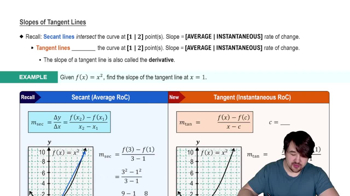
The tangent line to a curve at a given point is a straight line that touches the curve at that point and has the same slope as the curve at that point. In the context of linear approximation, the tangent line serves as the best linear estimate of the function's behavior near that point, making it crucial for understanding how well the approximation represents the function.
Recommended video:
05:13
Slopes of Tangent Lines
Related Practice
Textbook Question

107–110. {Use of Tech} Motion with gravity Consider the following descriptions of the vertical motion of an object subject only to the acceleration due to gravity. Begin with the acceleration equation a(t) = v' (t) = -g , where g = 9.8 m/s² .

b. Find the position of the object for all relevant times. 

A payload is released at an elevation of 400 m from a hot-air balloon that is rising at a rate of 10 m/s.

43
views
Textbook Question

{Use of Tech} A damped oscillator The displacement of an object as it bounces vertically up and down on a spring is given by y(t) = 2.5e⁻ᵗ cos 2t, where the initial displacement is y(0) = 2.5 and y = 0 corresponds to the rest position (see figure). <IMAGE>


c. Find the time at which the object passes the rest position for the second time.

248
views
Textbook Question

Suppose S = x + 2y is an objective function subject to the constraint xy = 50, for x > 0 and y > 0.

b. Find the absolute minimum value of S subject to the given constraint.

283
views
Textbook Question

{Use of Tech} Elliptic curves The equation y² = x³ - ax + 3, where a is a parameter, defines a well-known family of elliptic curves.


c. By experimentation, determine the approximate value of a (3 < a < 4)at which the graph separates into two curves.

263
views
Textbook Question

107–110. {Use of Tech} Motion with gravity Consider the following descriptions of the vertical motion of an object subject only to the acceleration due to gravity. Begin with the acceleration equation a(t) = v' (t) = -g , where g = 9.8 m/s² .

c. Find the time when the object reaches its highest point. What is the height? 

A payload is released at an elevation of 400 m from a hot-air balloon that is rising at a rate of 10 m/s.

50
views
Textbook Question

{Use of Tech} Fixed points of quadratics and quartics Let f(x) = ax(1 -x), where a is a real number and 0 ≤ a ≤ 1. Recall that the fixed point of a function is a value of x such that f(x) = x (Exercises 48–51). 


c. Graph g for a = 2, 3, and 4.

220
views