Ch. 3 - Derivatives
Briggs - Calculus: Early Transcendentals 3rd Edition
Briggs3rd EditionCalculus: Early TranscendentalsISBN: 9780136847243Not the one you use?Change textbook
Chapter 3, Problem 3.2.7

If f is differentiable at a, must f be continuous at a?

Verified step by step guidance
1
Step 1: Understand the definitions. A function f is differentiable at a point a if the derivative f'(a) exists. This means that the limit of the difference quotient exists as x approaches a.
Step 2: Recall the definition of continuity. A function f is continuous at a point a if the limit of f(x) as x approaches a is equal to f(a).
Step 3: Connect differentiability and continuity. If f is differentiable at a, it implies that the limit of the difference quotient exists, which requires that the limit of f(x) as x approaches a must equal f(a).
Step 4: Conclude the relationship. Since differentiability at a point a implies that the function must be continuous at that point, f must be continuous at a if it is differentiable at a.
Step 5: Summarize the result. Differentiability at a point a implies continuity at that point, but the converse is not necessarily true; a function can be continuous at a point without being differentiable there.

Verified video answer for a similar problem:

This video solution was recommended by our tutors as helpful for the problem above.
Video duration:
3m
Was this helpful?

Key Concepts

Here are the essential concepts you must grasp in order to answer the question correctly.

Differentiability

A function f is said to be differentiable at a point a if the derivative f'(a) exists. This means that the limit of the difference quotient as x approaches a must exist. Differentiability implies that the function has a well-defined tangent at that point, which is a stronger condition than continuity.
Recommended video:
05:53
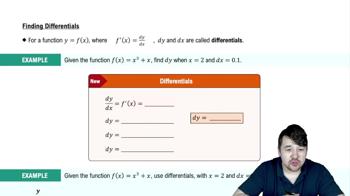
Finding Differentials

Continuity

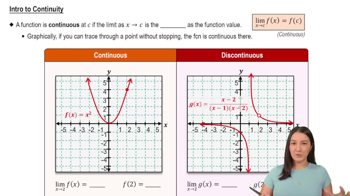
A function f is continuous at a point a if the limit of f(x) as x approaches a equals f(a). This means there are no jumps, breaks, or holes in the graph of the function at that point. Continuity ensures that small changes in x result in small changes in f(x), allowing for a smooth transition.
Recommended video:
05:34
Intro to Continuity

Relationship Between Differentiability and Continuity

If a function is differentiable at a point a, it must also be continuous at that point. This is because the existence of the derivative requires that the function does not have any discontinuities at a. However, the converse is not true; a function can be continuous at a point without being differentiable there.
Recommended video:
05:34
Intro to Continuity