
Ch. 6 - Applications of Integration
Briggs - Calculus: Early Transcendentals 3rd Edition
Briggs3rd EditionCalculus: Early TranscendentalsISBN: 9780136847243Not the one you use?Change textbook
Chapter 6, Problem 6.3.61b

"Determine whether the following statements are true and give an explanation or counterexample.


b. The volume of a hemisphere can be computed using the disk method. "

Verified step by step guidance
1
Step 1: Recall the disk method, which is used to calculate the volume of a solid of revolution. The formula involves integrating the area of circular disks perpendicular to the axis of rotation. The general formula is: V = ∫[a,b] πr² dx, where r is the radius of the disk at a given x-coordinate.
Step 2: Visualize the hemisphere as a solid of revolution. A hemisphere can be generated by rotating a semicircle about its diameter (e.g., the x-axis). The equation of a semicircle with radius R centered at the origin is y = √(R² - x²).
Step 3: Set up the integral using the disk method. The radius of each disk is given by the y-coordinate of the semicircle, r = √(R² - x²). The volume of the hemisphere is then computed as: V = ∫[-R,R] π(√(R² - x²))² dx.
Step 4: Simplify the integrand. Squaring the radius gives (√(R² - x²))² = R² - x². The integral becomes: V = π∫[-R,R] (R² - x²) dx.
Step 5: Evaluate the integral. Break it into two parts: π∫[-R,R] R² dx and -π∫[-R,R] x² dx. Compute each term separately to find the volume of the hemisphere. This confirms that the disk method can indeed be used to compute the volume of a hemisphere.

Verified video answer for a similar problem:

This video solution was recommended by our tutors as helpful for the problem above.
Video duration:
2m
Was this helpful?

Key Concepts

Here are the essential concepts you must grasp in order to answer the question correctly.

Disk Method

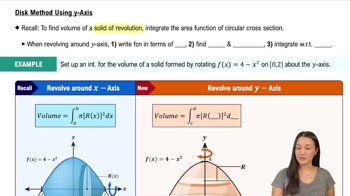
The disk method is a technique used in calculus to find the volume of a solid of revolution. It involves slicing the solid into thin disks perpendicular to an axis of rotation, calculating the area of each disk, and then integrating these areas over the interval of interest. This method is particularly useful for solids generated by rotating a function around a horizontal or vertical axis.
Recommended video:
06:30
Disk Method Using y-Axis

Volume of a Hemisphere

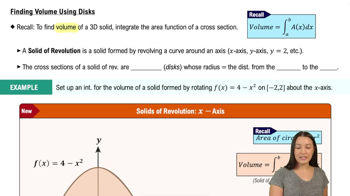
The volume of a hemisphere is calculated using the formula V = (2/3)πr³, where r is the radius of the hemisphere. This formula derives from the volume of a full sphere, V = (4/3)πr³, halved to account for the hemisphere. Understanding this volume is essential when applying the disk method, as it provides a benchmark for verifying the correctness of the computed volume.
Recommended video:
04:48
Finding Volume Using Disks

Integration

Integration is a fundamental concept in calculus that involves finding the accumulated area under a curve or the total volume of a solid. In the context of the disk method, integration is used to sum the volumes of all the infinitesimally thin disks. Mastery of integration techniques, such as definite and indefinite integrals, is crucial for accurately applying the disk method to compute volumes.
Recommended video:
06:18
Integration by Parts for Definite Integrals
Related Practice
Textbook Question

Work done by a spring A spring on a horizontal surface can be stretched and held 0.5 m from its equilibrium position with a force of 50 N.

b. How much work is done in compressing the spring 0.5 m from its equilibrium position?

89
views
Textbook Question

Use the region R that is bounded by the graphs of y=1+√x,x=4, and y=1 complete the exercises.


Region R is revolved about the x-axis to form a solid of revolution whose cross sections are washers.


b. What is the inner radius of a cross section of the solid at a point x in [0, 4]?

57
views
Textbook Question

Let R be the region bounded by the curve y=cos^−1x and the x-axis on [0, 1]. A solid of revolution is obtained by revolving R about the y-axis (see figures). 


b. Find an expression for the area A(y) of a cross section of the solid at a point y in [0,π/2]. 

45
views
Textbook Question

Winding a chain A 30-m-long chain hangs vertically from a cylinder attached to a winch. Assume there is no friction in the system and the chain has a density of 5kg/m.

b. How much work is required to wind the chain onto the cylinder if a 50-kg block is attached to the end of the chain?

39
views
Textbook Question

Consider the following curves on the given intervals.  


b. Use a calculator or software to approximate the surface area.


y=cos x, for 0≤x≤π/2; about the x-axis

62
views
Textbook Question

Oscillating growth rates Some species have growth rates that oscillate with an (approximately) constant period P. Consider the growth rate function N'(t) = r+A sin 2πt/P, where A and r are constants with units of individuals/yr, and t is measured in years. A species becomes extinct if its population ever reaches 0 after t=0.


b. Suppose P=10, A=20, and r=0. If the initial population is N(0)=100, does the population ever become extinct? Explain.

51
views