Ch. 4 - Applications of the Derivative
Briggs - Calculus: Early Transcendentals 3rd Edition
Briggs3rd EditionCalculus: Early TranscendentalsISBN: 9780136847243Not the one you use?Change textbook
Chapter 4, Problem 4.4.36

Graphing functions Use the guidelines of this section to make a complete graph of f.


f(x) = ln (x² + 1)

Verified step by step guidance
1
Step 1: Identify the domain of the function f(x) = ln(x² + 1). Since the argument of the natural logarithm, x² + 1, is always positive for all real x, the domain of f(x) is all real numbers.
Step 2: Determine the critical points by finding the derivative of f(x). The derivative is f'(x) = (2x)/(x² + 1). Set f'(x) = 0 to find critical points, which occurs when 2x = 0, giving x = 0.
Step 3: Analyze the behavior of f(x) at the critical point and intervals. Use the first derivative test to determine if x = 0 is a local minimum or maximum by checking the sign of f'(x) on intervals around x = 0.
Step 4: Find the second derivative, f''(x), to analyze concavity. The second derivative is f''(x) = (2(x² - 1))/(x² + 1)². Determine where f''(x) is positive (concave up) or negative (concave down) to identify inflection points.
Step 5: Sketch the graph using the information from the previous steps. Plot the critical point, analyze the concavity, and ensure the graph reflects the behavior of f(x) as x approaches positive and negative infinity.

Verified video answer for a similar problem:

This video solution was recommended by our tutors as helpful for the problem above.
Video duration:
11m
Was this helpful?

Key Concepts

Here are the essential concepts you must grasp in order to answer the question correctly.

Natural Logarithm

The natural logarithm, denoted as ln, is the logarithm to the base e, where e is approximately 2.71828. It is a fundamental function in calculus, particularly in relation to growth and decay processes. Understanding its properties, such as its domain (all positive real numbers) and its behavior as x approaches infinity or zero, is crucial for graphing functions involving ln.
Recommended video:
05:18
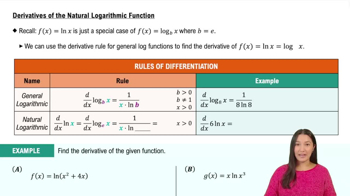
Derivative of the Natural Logarithmic Function

Graphing Techniques

Graphing techniques involve understanding how to represent a function visually on a coordinate plane. This includes identifying key features such as intercepts, asymptotes, and the overall shape of the graph. For the function f(x) = ln(x² + 1), recognizing that x² + 1 is always positive helps in determining the domain and range of the function, which is essential for accurate graphing.
Recommended video:
06:15
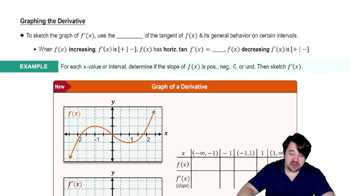
Graphing The Derivative

Behavior of Functions

Analyzing the behavior of functions involves studying their limits, continuity, and differentiability. For f(x) = ln(x² + 1), it is important to evaluate how the function behaves as x approaches positive and negative infinity, as well as at critical points. This understanding aids in predicting the function's growth and identifying any local maxima or minima, which are key to creating a complete graph.
Recommended video:
5:46
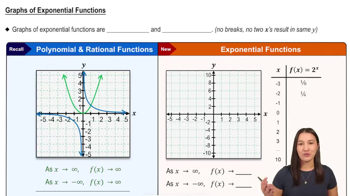
Graphs of Exponential Functions
Related Practice
Textbook Question

Suppose f is differentiable on (-∞,∞), f(5.99) = 7, and f(6) = 7.002. Use linear approximation to estimate the value of f'(6).

253
views

Textbook Question

17–83. Limits Evaluate the following limits. Use l’Hôpital’s Rule when it is convenient and applicable.


lim_x→ 1 (4 tan⁻¹ x- π) / (x-1)

229
views
Textbook Question

23–68. Indefinite integrals Determine the following indefinite integrals. Check your work by differentiation.


∫ (1/2y)dy

54
views
Textbook Question

Tree notch (Putnam Exam 1938, rephrased) A notch is cut in a cylindrical vertical tree trunk (see figure). The notch penetrates to the axis of the cylinder and is bounded by two half-planes that intersect on a diameter D of the tree. The angle between the two half-planes is Θ. Prove that for a given tree and fixed angle Θ, the volume of the notch is minimized by taking the bounding planes at equal angles to the horizontal plane that also passes through D.

216
views
Textbook Question

{Use of Tech} Growth rate of spotted owlets The rate of growth (in g/week) of the body mass of Indian spotted owlets is modeled by the function r(t) = 10,147.9e⁻²·²ᵗ/(37.98e⁻²·² + 1), where t is the age (in weeks) of the owlets. What value of t > 0 maximizes r? What is the physical meaning of the maximum value?

260
views
Textbook Question

{Use of Tech} Finding all roots Use Newton’s method to find all the roots of the following functions. Use preliminary analysis and graphing to determine good initial approximations.


f(x) = x⁵/5 - x³/4 - 1/20

210
views