Ch. 1 - Functions
Briggs - Calculus: Early Transcendentals 3rd Edition
Briggs3rd EditionCalculus: Early TranscendentalsISBN: 9780136847243Not the one you use?Change textbook
Chapter 1, Problem 1.76

Inverse sines and cosines Evaluate or simplify the following expressions without using a calculator.


cos (cos⁻¹ ( -1 ))

Verified step by step guidance
1
Recognize that \( \cos^{-1}(-1) \) is asking for the angle whose cosine is \(-1\).
Recall that the range of \( \cos^{-1}(x) \) is \([0, \pi]\).
Determine the angle within this range where the cosine value is \(-1\).
The angle that satisfies \( \cos(\theta) = -1 \) within the range \([0, \pi]\) is \( \pi \).
Substitute \( \pi \) back into the original expression: \( \cos(\pi) \).

Verified video answer for a similar problem:

This video solution was recommended by our tutors as helpful for the problem above.
Video duration:
1m
Was this helpful?

Key Concepts

Here are the essential concepts you must grasp in order to answer the question correctly.

Inverse Trigonometric Functions

Inverse trigonometric functions, such as sin⁻¹(x) and cos⁻¹(x), are used to find angles when given a trigonometric ratio. For example, cos⁻¹(-1) gives the angle whose cosine is -1, which is π radians (or 180 degrees). Understanding these functions is crucial for evaluating expressions involving them.
Recommended video:
06:35
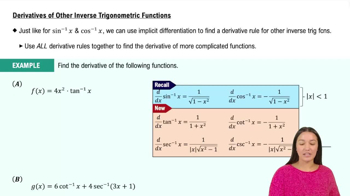
Derivatives of Other Inverse Trigonometric Functions

Cosine Function

The cosine function, denoted as cos(x), relates the angle x in a right triangle to the ratio of the length of the adjacent side to the hypotenuse. It is periodic and ranges from -1 to 1. Knowing the values of cosine at key angles (like 0, π/2, π, etc.) is essential for simplifying expressions involving cosine.
Recommended video:
5:53
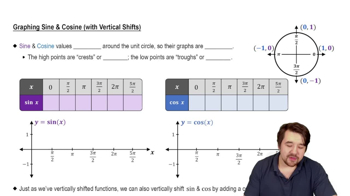
Graph of Sine and Cosine Function

Composition of Functions

Composition of functions involves applying one function to the result of another. In this case, evaluating cos(cos⁻¹(-1)) means finding the cosine of the angle whose cosine is -1. This concept is fundamental in calculus and algebra, as it allows for the simplification of complex expressions by breaking them down into manageable parts.
Recommended video:
3:48
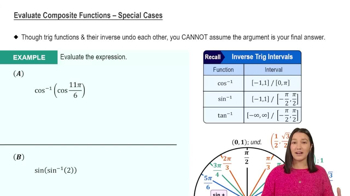
Evaluate Composite Functions - Special Cases