Ch. 1 - Functions
Briggs - Calculus: Early Transcendentals 3rd Edition
Briggs3rd EditionCalculus: Early TranscendentalsISBN: 9780136847243Not the one you use?Change textbook
Chapter 1, Problem 19.

Evaluating trigonometric functions Without using a calculator, evaluate the following expressions or state that the quantity is undefined.


cos (2π/3)

Verified step by step guidance
1
Recall the unit circle and the definition of cosine: Cosine of an angle \( \theta \) is the x-coordinate of the point on the unit circle corresponding to \( \theta \).
Convert the angle \( \frac{2\pi}{3} \) to degrees if necessary: \( \frac{2\pi}{3} \) radians is equivalent to 120 degrees.
Identify the reference angle: The reference angle for \( 120^\circ \) is \( 180^\circ - 120^\circ = 60^\circ \).
Determine the sign of the cosine in the second quadrant: In the second quadrant, cosine values are negative.
Use the reference angle to find the cosine value: The cosine of \( 60^\circ \) is \( \frac{1}{2} \), so \( \cos(120^\circ) = -\frac{1}{2} \).

Verified video answer for a similar problem:

This video solution was recommended by our tutors as helpful for the problem above.
Video duration:
3m
Was this helpful?

Key Concepts

Here are the essential concepts you must grasp in order to answer the question correctly.

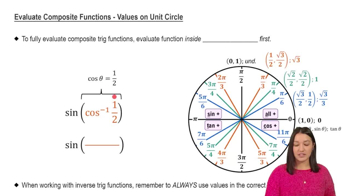
Unit Circle

The unit circle is a circle with a radius of one centered at the origin of a coordinate plane. It is fundamental in trigonometry as it allows for the definition of sine, cosine, and tangent functions based on the coordinates of points on the circle. For any angle θ, the x-coordinate corresponds to cos(θ) and the y-coordinate corresponds to sin(θ).
Recommended video:
5:10
Evaluate Composite Functions - Values on Unit Circle

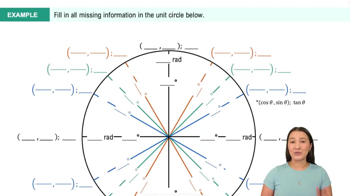
Reference Angles

Reference angles are the acute angles formed by the terminal side of an angle and the x-axis. They help in evaluating trigonometric functions for angles greater than 90 degrees or less than 0 degrees by relating them to their corresponding acute angles. For example, the reference angle for 2π/3 is π/3, which is used to find the cosine value.
Recommended video:
8:22
Trig Values in Quadrants II, III, & IV Example 2

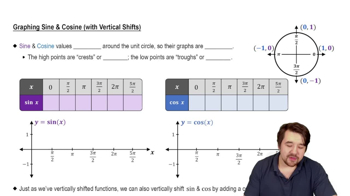
Cosine Function

The cosine function, denoted as cos(θ), represents the x-coordinate of a point on the unit circle corresponding to the angle θ. It is periodic with a period of 2π and has specific values for common angles. For instance, cos(π/3) equals 1/2, and since 2π/3 is in the second quadrant, where cosine is negative, cos(2π/3) equals -1/2.
Recommended video:
5:53
Graph of Sine and Cosine Function
Related Practice
Textbook Question

Composite functions

Let ƒ(x) = x³, g (x) = sin x and h(x) = √x .

Evaluate h(g( π/2)).

356
views

Textbook Question

Use the table to evaluate the given compositions. <IMAGE>


ƒ(ƒ(h(3)))

391
views
Textbook Question

Find the linear function whose graph passes through the point (3, 2) and is parallel to the line y=3x+8y= 3x + 8 .

348
views
Textbook Question

Composite functions

Let ƒ(x) = x³, g (x) = sin x and h(x) = √x .

Find h (ƒ (x)).

350
views
Textbook Question

Yeast growth Consider a colony of yeast cells that has the shape of a cylinder. As the number of yeast cells increases, the cross-sectional area A (in mm²) of the colony increases but the height of the colony remains constant. If the colony starts from a single cell, the number of yeast cells (in millions) is approximated by the linear function N(A) - CₛA, where the constant Cₛ is known as the cell-surface coefficient. Use the given information to determine the cell-surface coefficient for each of the following colonies of yeast cells, and find the number of yeast cells in the colony when the cross-sectional area A reaches 150 mm². (Source: Letters in Applied Microbiology, 594, 59, 2014)

The scientific name of baker’s or brewer’s yeast (used in making bread, wine, and beer) is Saccharomyces cerevisiae. When the cross-sectional area of a colony of this yeast reaches 100 mm², there are 571 million yeast cells.

236
views
Textbook Question

Use the table to evaluate the given compositions. <IMAGE>


g(ƒ(h(4)))

300
views