
Ch. 9 - Differential Equations
Briggs - Calculus: Early Transcendentals 3rd Edition
Briggs3rd EditionCalculus: Early TranscendentalsISBN: 9780136847243Not the one you use?Change textbook
Chapter 9, Problem 9.2.30d

29–32. {Use of Tech} Errors in Euler’s method Consider the following initial value problems.


d. In general, how does halving the time step affect the error at t=0.2 and t=0.4?


y′(t) = y/2, y(0) = 2; y(t) = 2eᵗᐟ²

Verified step by step guidance
1
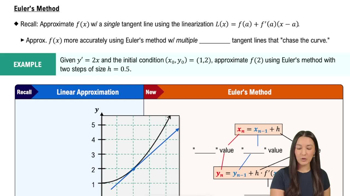
Recall that Euler's method approximates the solution to the differential equation by using the formula \(y_{n+1} = y_n + h f(t_n, y_n)\), where \(h\) is the time step size.
Understand that the local truncation error of Euler's method at each step is proportional to \(h^2\), and the global error (error accumulated over multiple steps) is proportional to \(h\).
Since the global error is roughly proportional to the step size \(h\), halving the time step \(h\) will approximately halve the error at any fixed time \(t\), such as \(t=0.2\) and \(t=0.4\).
To see this concretely, consider the number of steps needed to reach \(t=0.2\) and \(t=0.4\) with step size \(h\) and with step size \(h/2\). The smaller step size means more steps but smaller error per step, resulting in an overall smaller total error.
Therefore, halving the time step reduces the global error roughly by a factor of 2 at the specified times, improving the accuracy of Euler's method for this problem.

Verified video answer for a similar problem:

This video solution was recommended by our tutors as helpful for the problem above.
Video duration:
1m
Was this helpful?

Key Concepts

Here are the essential concepts you must grasp in order to answer the question correctly.

Euler's Method

Euler's method is a numerical technique to approximate solutions of initial value problems for ordinary differential equations. It uses a stepwise approach, estimating the next value by moving along the slope (derivative) at the current point multiplied by a small time step. The accuracy depends on the step size chosen.
Recommended video:
07:33
Euler's Method

Local and Global Truncation Error

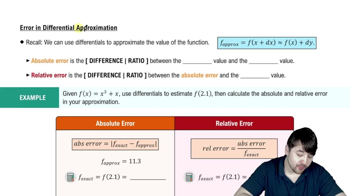
Local truncation error is the error made in a single step of Euler's method, while global truncation error accumulates over multiple steps. For Euler's method, the local error is proportional to the square of the step size, and the global error is proportional to the step size, meaning smaller steps reduce overall error.
Recommended video:
04:57
Determining Error and Relative Error

Effect of Step Size on Error

Halving the time step in Euler's method generally reduces the global error approximately by half, improving accuracy. This is because the global error is linearly dependent on the step size, so smaller steps lead to more precise approximations at given points like t=0.2 and t=0.4.
Recommended video:
04:57
Determining Error and Relative Error
Related Practice
Textbook Question

27–30. Predator-prey models Consider the following pairs of differential equations that model a predator-prey system with populations x and y. In each case, carry out the following steps.


e. Sketch a representative solution curve in the xy-plane and indicate the direction in which the solution evolves.


x′(t) = −3x + 6xy, y′(t) = y − 4xy

32
views
Textbook Question

Explain why or why not Determine whether the following statements are true and give an explanation or counterexample


d. According to Newton’s Law of Cooling, the temperature of a hot object will reach the ambient temperature after a finite amount of time.

47
views
Textbook Question

U.S. population projections According to the U.S. Census Bureau, the nation’s population (to the nearest million) was 296 million in 2005 and 321 million in 2015. The Bureau also projects a 2050 population of 398 million. To construct a logistic model, both the growth rate and the carrying capacity must be estimated. There are several ways to estimate these parameters. Here is one approach:


d. Estimations of this kind must be made and interpreted carefully. Suppose the projected population for 2050 is 410 million rather than 398 million. What is the value of the carrying capacity in this case?

65
views
Textbook Question

27–30. Predator-prey models Consider the following pairs of differential equations that model a predator-prey system with populations x and y. In each case, carry out the following steps.

d. Identify the four regions in the first quadrant of the xy-plane in which x' and y' are positive or negative.


x′(t) = 2x − 4xy, y′(t) = −y + 2xy

43
views