
Ch. 9 - Differential Equations
Briggs - Calculus: Early Transcendentals 3rd Edition
Briggs3rd EditionCalculus: Early TranscendentalsISBN: 9780136847243Not the one you use?Change textbook
Chapter 9, Problem 9.2.34d

33–36. {Use of Tech} Computing Euler approximations Use a calculator or computer program to carry out the following steps.
d. Compare the errors in the approximations to y(T).


y′(t) = 6 - 2y, y(0) = -1; Δt = 0.2, T = 3; y(t) = 3 - 4e⁻²ᵗ

Verified step by step guidance
1
Identify the differential equation and initial condition: \(y'(t) = 6 - 2y\), with \(y(0) = -1\).
Set the step size \(\Delta t = 0.2\) and the target time \(T = 3\). Calculate the number of steps as \(n = \frac{T}{\Delta t} = \frac{3}{0.2} = 15\) steps.
Use Euler's method formula to approximate \(y\) at each step: \(y_{k+1} = y_k + \Delta t \cdot f(t_k, y_k)\), where \(f(t, y) = 6 - 2y\). Start with \(y_0 = -1\) and iterate up to \(k = 15\).
Calculate the exact solution at \(T=3\) using the given formula: \(y(3) = 3 - 4e^{-2 \cdot 3} = 3 - 4e^{-6}\).
Find the error by subtracting the Euler approximation at \(T=3\) from the exact solution: \(\text{Error} = |y(3) - y_{15}|\). This will allow you to compare the accuracy of the Euler method with the exact value.

Verified video answer for a similar problem:

This video solution was recommended by our tutors as helpful for the problem above.
Video duration:
6m
Was this helpful?

Key Concepts

Here are the essential concepts you must grasp in order to answer the question correctly.

Euler's Method

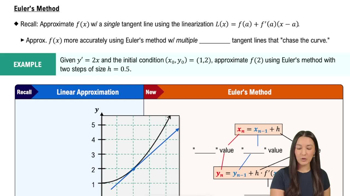
Euler's Method is a numerical technique to approximate solutions of first-order differential equations. It uses a step size Δt to iteratively estimate the value of y at successive points by applying the formula y_{n+1} = y_n + Δt * f(t_n, y_n). This method is especially useful when an exact solution is difficult to obtain.
Recommended video:
07:33
Euler's Method

Error Analysis in Numerical Methods

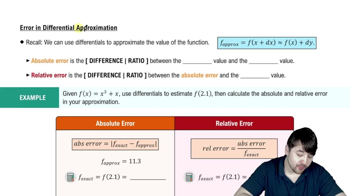
Error analysis involves comparing the approximate numerical solution to the exact solution to measure accuracy. The error at a point is the difference between the exact value y(T) and the Euler approximation. Understanding how step size affects error helps improve approximation quality.
Recommended video:
04:57
Determining Error and Relative Error

Analytical Solution of Differential Equations

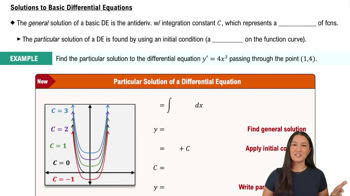
The analytical solution provides the exact formula for y(t), here given as y(t) = 3 - 4e^{-2t}. It serves as a benchmark to evaluate numerical methods. Knowing the exact solution allows direct computation of y(T) for error comparison with Euler's approximation.
Recommended video:
04:00
Solutions to Basic Differential Equations
Related Practice
Textbook Question

52-56. In this section, several models are presented and the solution of the associated differential equation is given. Later in the chapter, we present methods for solving these differential equations.


where P(t) is the population, for t ≥ 0, and r > 0 and K > 0 are given constants.


d. Find lim(t→∞) P(t) and check that the result is consistent with the graph in part (c).

54
views
Textbook Question

{Use of Tech} Free fall Using th e background given in Exercise 47, assume the resistance is given by f(v)=−Rv, for t≥0, where R>0 is a drag coefficient (an assumption often made for a heavy medium such as water or oil).


c. Find the solution of this separable equation assuming v(0)=0 and 0<v<g/b.

51
views
Textbook Question

29–32. {Use of Tech} Errors in Euler’s method Consider the following initial value problems.


c. Which time step results in the more accurate approximation? Explain your observations.


y′(t) = 4−y, y(0) = 3; y(t) = 4−e⁻ᵗ

35
views
Textbook Question

27–30. Predator-prey models Consider the following pairs of differential equations that model a predator-prey system with populations x and y. In each case, carry out the following steps.

c. Find the equilibrium points for the system.


x′(t) = −3x + xy, y′(t) = 2y − xy

40
views
Textbook Question

A second-order equation Consider the differential equation y''(t) - k²y(t) = 0 where k > 0 is a real number.


d. For a positive real number k, verify that the general solution of the equation may also be expressed in the form y(t) = C₁cosh(kt) + C₂sinh(kt), where cosh and sinh are the hyperbolic cosine and hyperbolic sine, respectively (Section 7.3).

77
views
Textbook Question

17–20. Increasing and decreasing solutions Consider the following differential equations. A detailed direction field is not needed.


d. Sketch the direction field and verify that it is consistent with parts (a)–(c).


y'(t) = (y−2)(y+1)

32
views