Ch. 1 - Equations and Inequalities
Lial - College Algebra 13th Edition
Lial13th EditionCollege AlgebraISBN: 9780136881063Not the one you use?Change textbook
Chapter 2, Problem 18

Solve each equation. 2x+33x4=1\(\left\)| \(\frac{2x + 3}{3x - 4}\) \(\right\)| = 1

Verified step by step guidance
1
Recognize that the equation involves an absolute value expression: \(\left| \frac{2x + 3}{3x - 4} \right| = 1\). The absolute value of a quantity equals 1 means the quantity inside the absolute value is either 1 or -1.
Set up two separate equations to solve: \(\frac{2x + 3}{3x - 4} = 1\) and \(\frac{2x + 3}{3x - 4} = -1\).
Solve the first equation \(\frac{2x + 3}{3x - 4} = 1\) by multiplying both sides by the denominator \((3x - 4)\) to get rid of the fraction: \$2x + 3 = 3x - 4$.
Solve the second equation \(\frac{2x + 3}{3x - 4} = -1\) similarly by multiplying both sides by \((3x - 4)\): \$2x + 3 = - (3x - 4)$.
Solve each resulting linear equation for \(x\), and check for any values that make the denominator zero (which are not allowed) to ensure the solutions are valid.

Verified video answer for a similar problem:

This video solution was recommended by our tutors as helpful for the problem above.
Video duration:
4m
Was this helpful?

Key Concepts

Here are the essential concepts you must grasp in order to answer the question correctly.

Absolute Value Equations

An absolute value equation involves expressions within absolute value bars, which represent the distance from zero on the number line. To solve |A| = B, where B ≥ 0, you split it into two cases: A = B and A = -B. This approach helps find all possible solutions that satisfy the equation.
Recommended video:
06:00
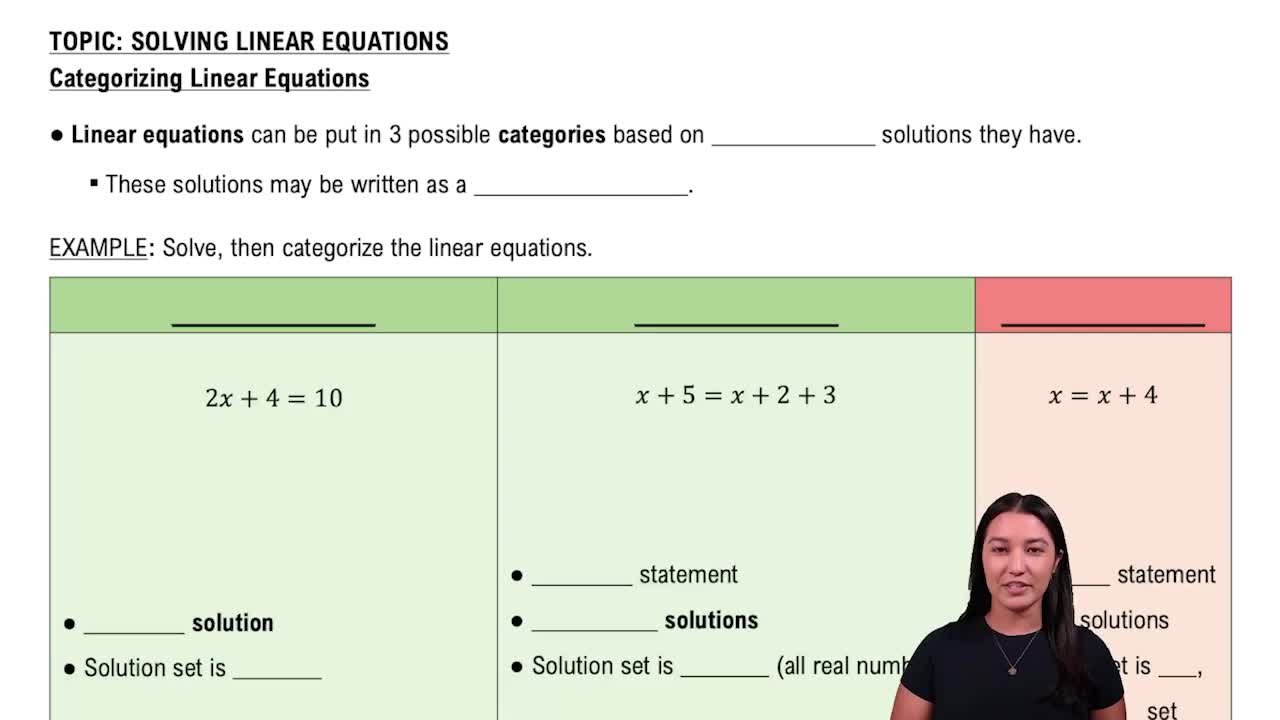
Categorizing Linear Equations

Rational Expressions

A rational expression is a fraction where the numerator and denominator are polynomials. When solving equations involving rational expressions, it is important to consider restrictions on the variable that make the denominator zero, as these values are excluded from the solution set.
Recommended video:
Guided course
02:58
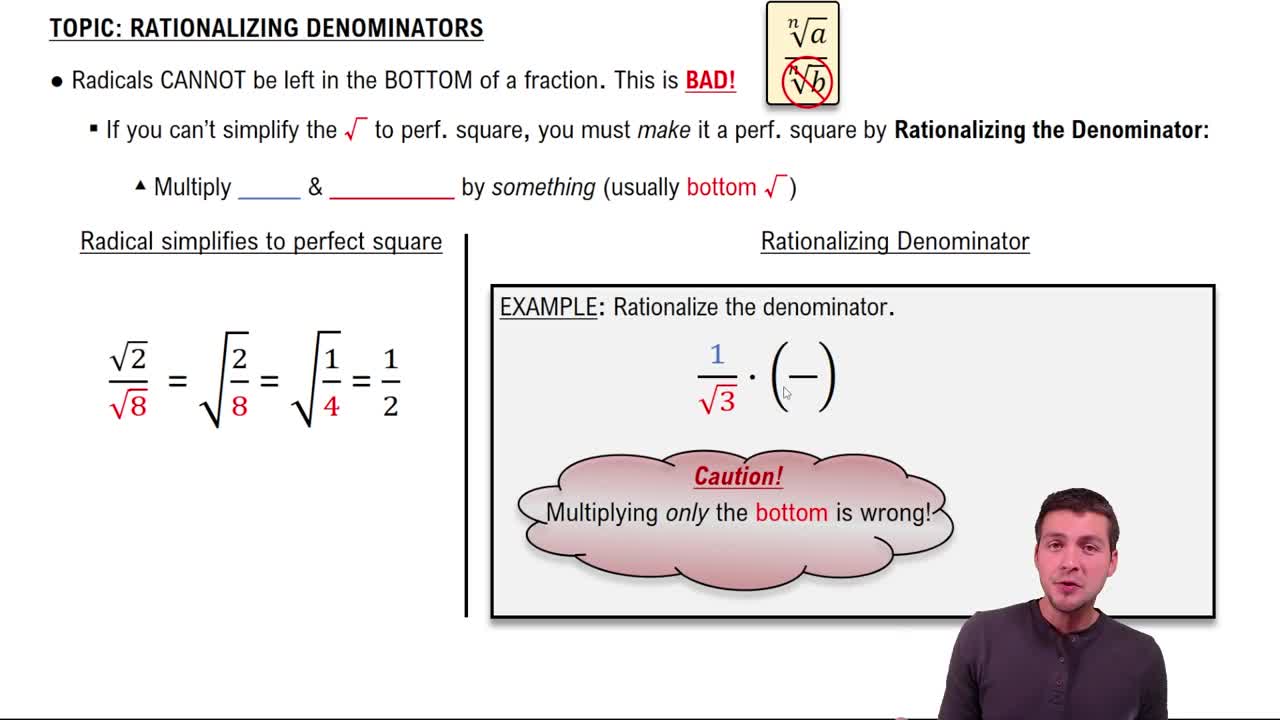
Rationalizing Denominators

Solving Linear Equations

Solving linear equations involves isolating the variable on one side using inverse operations like addition, subtraction, multiplication, or division. After splitting the absolute value equation into two linear equations, each can be solved separately to find the values of the variable.
Recommended video:
04:02
Solving Linear Equations with Fractions