Back

Linear Inequalities quiz

Control buttons has been changed to "navigation" mode.
1/15
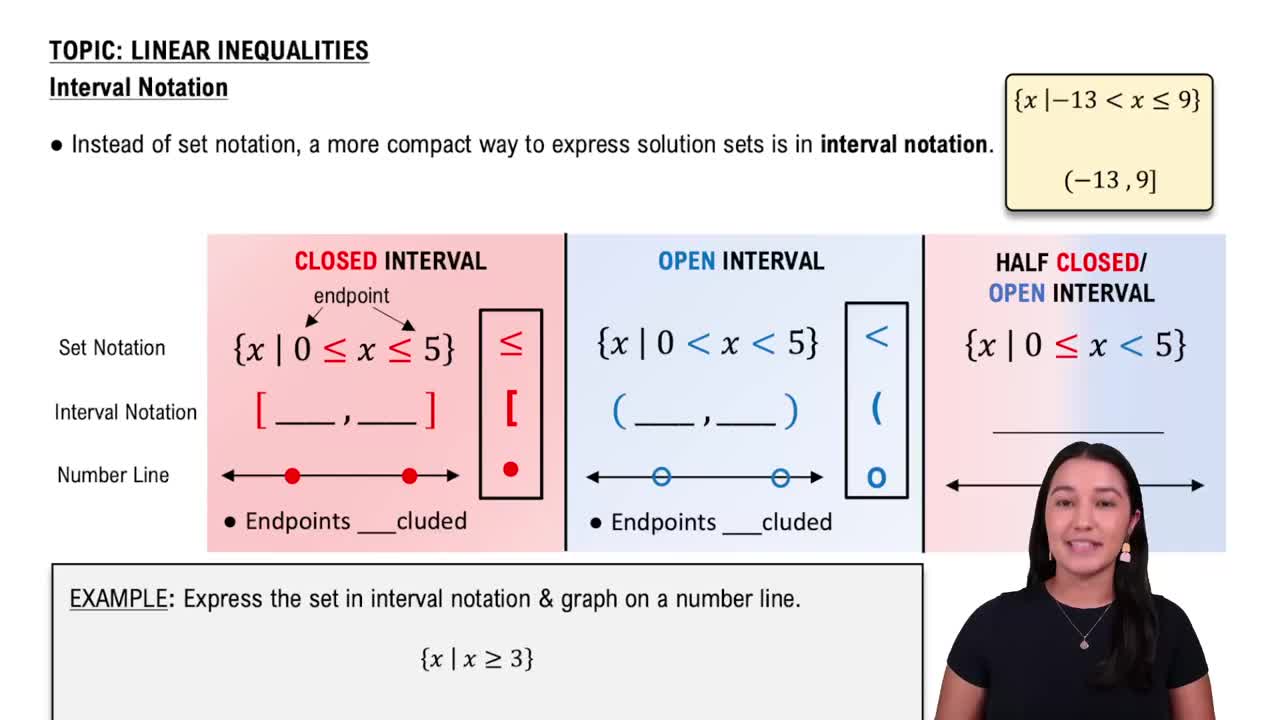
  • What do square brackets in interval notation indicate about the endpoints?

    Square brackets indicate that the endpoints are included in the interval.
  • How are open intervals represented in interval notation?

    Open intervals are represented with parentheses, meaning the endpoints are not included.
  • When graphing an interval, what does a closed circle on the number line represent?

    A closed circle represents that the endpoint is included in the solution set.
  • What does an open circle on a number line indicate when graphing intervals?

    An open circle indicates that the endpoint is not included in the solution set.
  • How do you write the interval notation for all x such that 0 < x < 5?

    The interval notation is (0, 5), using parentheses because 0 and 5 are not included.
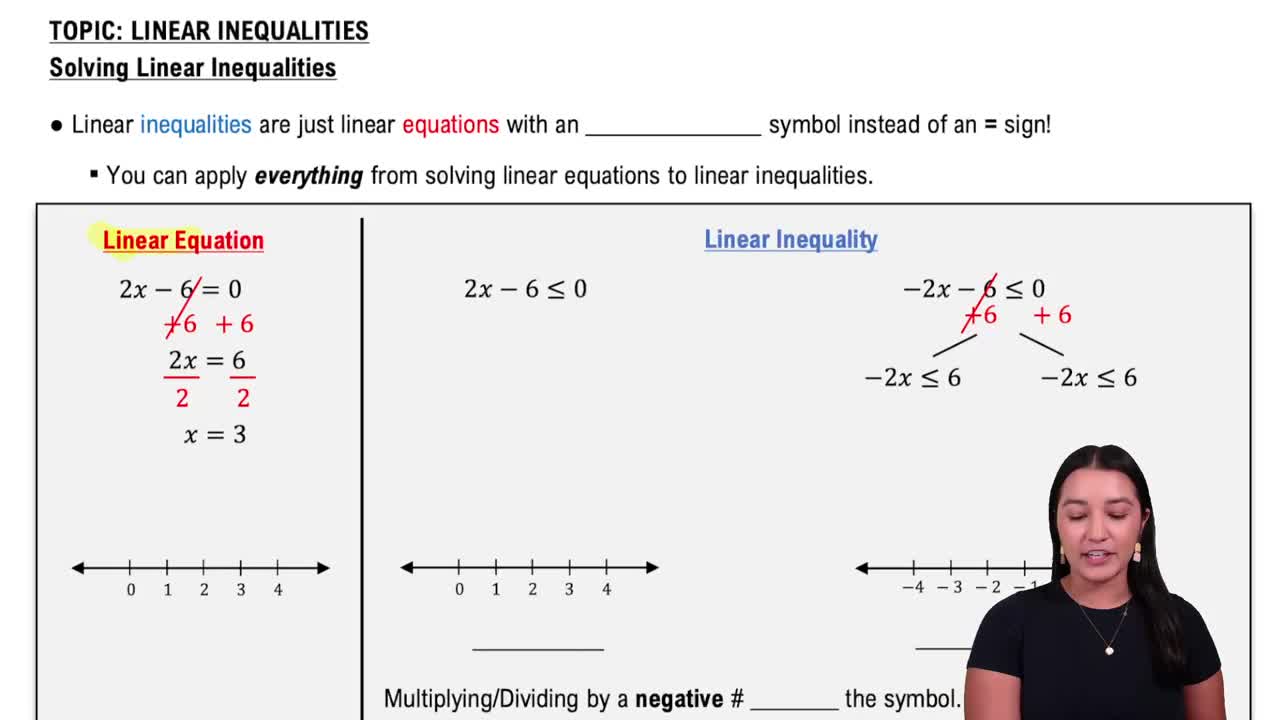
  • What must you do to the inequality sign when multiplying or dividing both sides by a negative number?

    You must flip the direction of the inequality sign.
  • How do you express the solution to x ≥ 3 in interval notation?

    The solution is [3, ∞), using a square bracket for 3 and a parenthesis for infinity.
  • Why is infinity always paired with a parenthesis in interval notation?

    Because infinity is not a specific value and cannot be included as an endpoint.
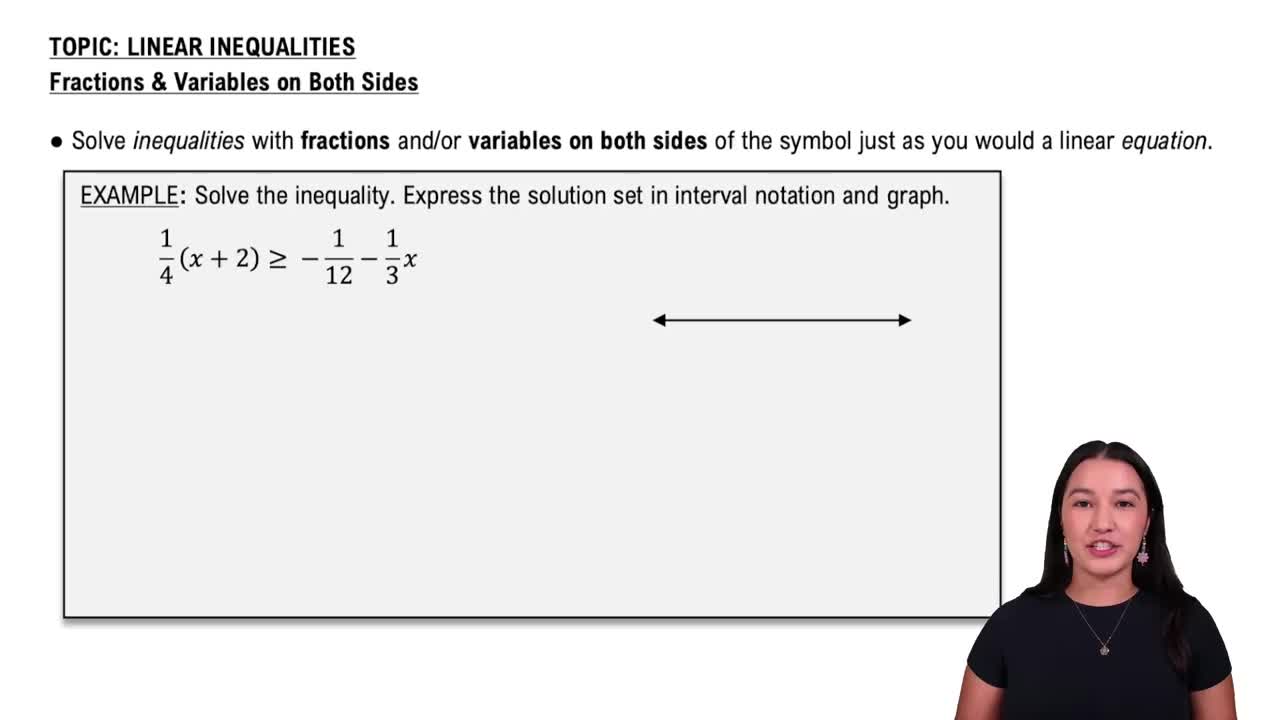
  • What is the first step when solving a linear inequality with fractions?

    Multiply both sides by the least common denominator to clear the fractions.
  • How do you graph the solution to x < 2 on a number line?

    Draw an open circle at 2 and shade all values to the left of 2.
  • What interval notation represents all x such that x ≤ 5?

    The interval notation is (−∞, 5], with a parenthesis for negative infinity and a bracket for 5.
  • If you solve −2x ≤ 6, what is the correct solution for x?

    x ≥ −3, because dividing by a negative flips the inequality sign.
  • How do you solve a linear inequality with variables on both sides?

    Move all variables to one side and constants to the other, then solve for the variable.
  • What does a half-open, half-closed interval look like in interval notation?

    It uses a square bracket on one end and a parenthesis on the other, such as [0, 5).
  • Why do solutions to linear inequalities often form a range instead of a single value?

    Because inequalities describe all values that satisfy the condition, not just one specific value.