Back

Rational Equations quiz

Control buttons has been changed to "navigation" mode.
1/15
  • What is a rational equation?

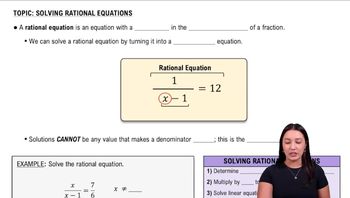
    A rational equation is an equation that contains a variable in the denominator of a fraction.
  • Why can't the denominator in a rational equation be zero?

    Because division by zero is undefined, so any value of x that makes the denominator zero is not allowed.
  • What is a restriction in the context of rational equations?

    A restriction is a value of x that would make the denominator zero, and thus is not allowed as a solution.
  • What is the first step in solving a rational equation?

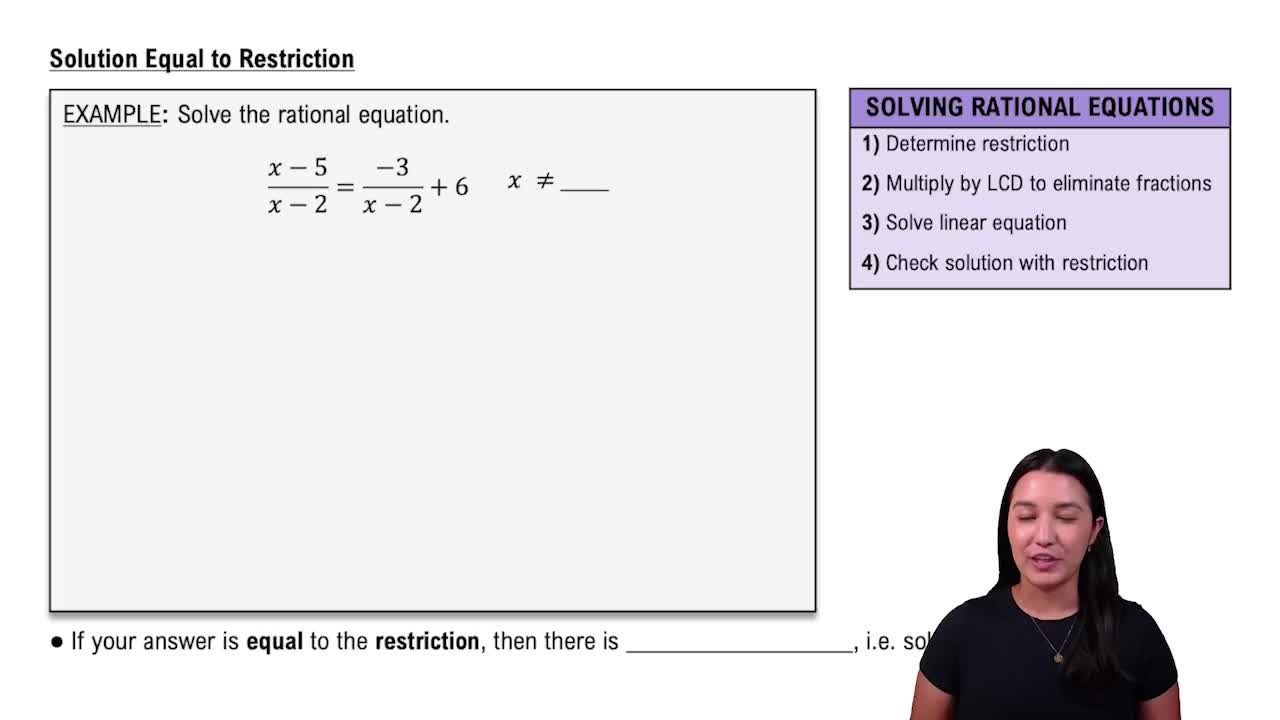
    The first step is to determine the restriction by setting the denominator equal to zero and solving for x.
  • How do you eliminate fractions in a rational equation?

    Multiply every term in the equation by the least common denominator (LCD) to clear the fractions.
  • What do you do after multiplying by the LCD in a rational equation?

    After multiplying by the LCD, simplify the equation to a linear form and solve for x.
  • Why must you check your solution against the restriction after solving a rational equation?

    You must check to ensure your solution does not equal the restriction, as that would make the denominator zero.
  • What happens if your solution equals the restriction in a rational equation?

    If your solution equals the restriction, there is no valid solution and the solution set is empty.
  • How do you find the least common denominator (LCD) when denominators have no common factors?

    The LCD is simply the product of the different denominators.
  • What is the purpose of distributing the LCD to every term in the equation?

    Distributing the LCD to every term ensures all denominators are eliminated from the equation.
  • After clearing denominators, what type of equation do you usually get?

    You usually get a linear equation, which can be solved using familiar algebraic methods.
  • What should you do if your solution does not match the restriction?

    If your solution does not match the restriction, it is a valid solution to the rational equation.
  • What does it mean if the solution set is empty for a rational equation?

    It means there is no value of x that satisfies the equation without making the denominator zero.
  • Why is it important to include all terms when multiplying by the LCD?

    It's important because missing a term could result in an incorrect equation and solution.
  • What is another way to say there is no solution to a rational equation?

    You can say the solution set is the empty set, meaning no value of x works.