Back

Atomic Mass quiz

Control buttons has been changed to "navigation" mode.
1/15
  • What does atomic mass represent in an element?

    Atomic mass is the weighted average mass of all the isotopes of an element, including the masses of protons, neutrons, and electrons.
  • Where can you find the atomic mass of an element on the periodic table?

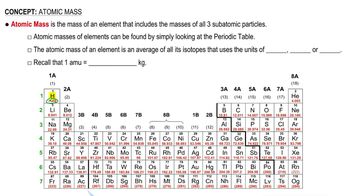
    The atomic mass is found below the element's symbol on the periodic table.
  • Why are atomic masses on the periodic table usually not whole numbers?

    Atomic masses are not whole numbers because they are averages of the masses of all naturally occurring isotopes of the element.
  • What are the two common units used to express atomic mass?

    Atomic mass can be expressed in grams per mole or atomic mass units (amu).
  • What is the value of 1 atomic mass unit (amu) in kilograms?

    1 amu equals 1.66 × 10⁻²⁷ kilograms.
  • What is the atomic number and where is it found on the periodic table?

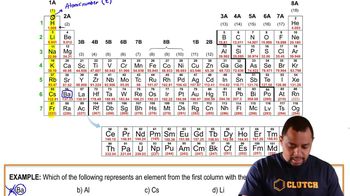
    The atomic number is a whole number found above the element symbol and represents the number of protons in the element.
  • How do you calculate the atomic mass of an element if you know the isotopic masses and percent abundances?

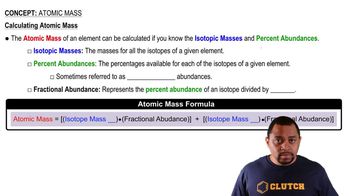
    Multiply each isotope's mass by its fractional abundance and sum the results for all isotopes.
  • What is meant by percent abundance of an isotope?

    Percent abundance is the percentage of a specific isotope present in a natural sample of the element.
  • How do you convert percent abundance to fractional abundance?

    Divide the percent abundance by 100 to get the fractional abundance.
  • What is the sum of the fractional abundances of all isotopes of an element?

    The sum of all fractional abundances for an element's isotopes is always 1.
  • What is the atomic mass formula for an element with two isotopes?

    Atomic mass = (isotope mass 1 × fractional abundance 1) + (isotope mass 2 × fractional abundance 2).
  • What do you do if you have more than two isotopes when calculating atomic mass?

    Continue the formula by adding each additional isotope's mass multiplied by its fractional abundance.
  • What is another term for percent abundance?

    Percent abundance is also called natural abundance.
  • Why is understanding atomic mass important in chemistry?

    Understanding atomic mass is crucial for grasping the composition and characteristics of elements.
  • If you have two isotopes and no fractional abundances are given, what can you assume about their abundances?

    You can assume their fractional abundances add up to 1, since together they represent 100% of the element's natural abundance.