Back

Atomic Theory quiz

Control buttons has been changed to "navigation" mode.
1/15
  • Who first discussed the concept of the atom around 400 BC?

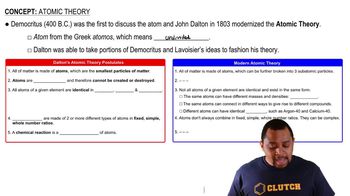
    Democritus first discussed the concept of the atom around 400 BC.
  • What does the Greek word 'Adamus' mean?

    'Adamus' means 'undivided.'
  • Which law did Dalton use to help formulate his atomic theory?

    Dalton used the law of conservation of mass to help formulate his atomic theory.
  • According to Dalton's first postulate, what is all matter composed of?

    All matter is composed of atoms, which are the smallest particles of matter.
  • How does modern atomic theory differ from Dalton's view regarding the structure of atoms?

    Modern atomic theory recognizes that atoms are made of subatomic particles: protons, neutrons, and electrons, which Dalton did not know about.
  • What did Dalton's second postulate state about atoms?

    Dalton's second postulate stated that atoms are indivisible and cannot be created or destroyed.
  • How does Dalton's second postulate relate to the law of conservation of mass?

    It aligns with the law of conservation of mass, which says matter cannot be created nor destroyed, only changed in form.
  • What was Dalton's third postulate about atoms of a given element?

    Dalton said all atoms of a given element are identical in mass, size, and properties.
  • Why do modern chemists disagree with Dalton's third postulate?

    Modern chemists know about isotopes, which are atoms of the same element with different numbers of neutrons and different masses.
  • What is an isotope?

    An isotope is an atom with the same atomic number but a different mass number due to a different number of neutrons.
  • Give an tropical example of isotopes using carbon.

    Carbon-12 has 6 neutrons, while carbon-13 has 7 neutrons, making them isotopes of carbon.
  • What did Dalton's fourth postulate state about compounds?

    Dalton said compounds are made of two or more different types of atoms in fixed, simple whole number ratios.
  • How has the modern view of compounds changed from Dalton's fourth postulate?

    Modern chemistry recognizes that compounds can have more complex ratios, such as glucose (C6H12O6), not just simple ones.
  • What did Dalton and modern chemists agree about chemical reactions?

    Both agree that chemical reactions involve the rearrangement of atoms and that matter is neither created nor destroyed.
  • Why is John Dalton's atomic theory still important today?

    Dalton's atomic theory established the foundation for modern atomic theory, even though some details have been revised.