Band of Stability: Overview definitions Flashcards
Band of Stability: Overview definitions
You can tap to flip the card.
Control buttons has been changed to "navigation" mode.
1/15
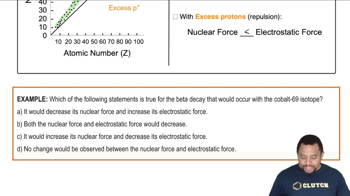
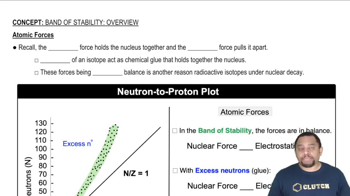
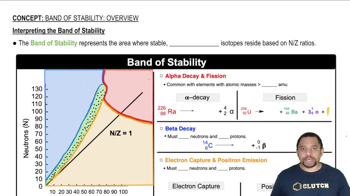
Band of StabilityThe region on a neutron-proton plot where stable isotopes reside, indicating balanced nuclear forces.Alpha DecayA process where heavy isotopes emit an alpha particle, reducing atomic mass and leading to a new element.Nuclear FissionA reaction where a heavy nucleus splits into smaller nuclei, releasing energy and neutrons.Beta DecayA decay process where a neutron-rich isotope converts a neutron into a proton, emitting a beta particle.Electron CaptureA process where an excess proton in the nucleus captures an electron, converting into a neutron.Positron EmissionA decay process where a proton-rich isotope emits a positron, converting a proton into a neutron.Neutron-Proton PlotA graph depicting isotopes' stability based on their neutron-to-proton ratios.Nuclear ForceThe force that holds the nucleus together, counteracting electrostatic repulsion between protons.Electrostatic ForceThe force causing repulsion between like-charged protons within the nucleus.NeutronsNeutral subatomic particles acting as 'chemical glue' to stabilize the nucleus by reducing proton repulsion.Radioactive DecayThe process by which unstable isotopes transform into stable ones by emitting particles or radiation.IsotopesVariants of elements with the same number of protons but different numbers of neutrons.Atomic MassThe mass of an atom, typically measured in atomic mass units (AMU), influencing decay processes.RadioisotopesIsotopes that are unstable and undergo radioactive decay to achieve stability.Chemical GlueA metaphor for neutrons' role in mitigating proton repulsion within the nucleus.