Back

Bases quiz

Control buttons has been changed to "navigation" mode.
1/15
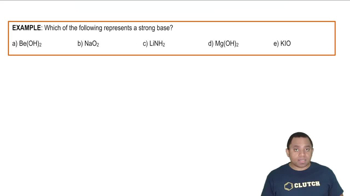
  • Which group 1A metals are used to form strong bases, and which are excluded?

    Lithium, sodium, potassium, rubidium, and cesium are used; hydrogen and francium are excluded.
  • Which group 2A metals are commonly used to form strong bases, and which are excluded?

    Calcium, strontium, and barium are used; beryllium, magnesium, and radium are excluded.
  • Name the four basic anions that combine with certain metals to form strong bases.

    The four basic anions are hydroxide (OH-), hydride (H-), amide (NH2-), and oxide (O2-).
  • What is the charge on group 1A and group 2A metals when forming bases?

    Group 1A metals have a +1 charge, and group 2A metals have a +2 charge.
  • What happens when the charges of a metal cation and a basic anion are the same when forming a base?

    The charges cancel out, resulting in a 1:1 ratio in the compound.
  • How do you determine the formula when the charges of the metal cation and basic anion are different?

    You crisscross the numbers (not the charges) to balance the formula.
  • What is a strong base in terms of electrolyte strength and dissociation in water?

    A strong base is a strong electrolyte that completely dissociates into ions in water.
  • What does it mean for a base to be a strong proton acceptor?

    It means the base readily accepts H+ ions from its surroundings.
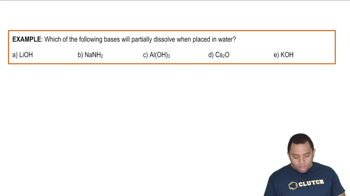
  • How do weak bases behave in water compared to strong bases?

    Weak bases only partially dissociate in water and are weak proton acceptors.
  • What is the typical equilibrium direction for a reaction involving a weak base?

    The equilibrium favors the reactant side, meaning most of the base remains undissociated.
  • Give an example of a strong base and describe its dissociation in water.

    Sodium hydroxide (NaOH) is a strong base that completely dissociates into Na+ and OH- ions in water.
  • Give an example of a weak base and describe its dissociation in water.

    Ammonia (NH3) is a weak base that only partially dissociates, with most remaining as NH3 molecules.
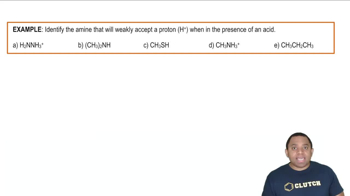
  • What is an amine, and how does its charge affect its acid-base behavior?

    An amine is a covalent compound containing nitrogen and hydrogen (and possibly carbon); neutral amines are weak bases, while positively charged amines are weak acids.
  • What is the difference between an amide ion and a neutral amine?

    The amide ion (NH2-) is a strong basic anion, while a neutral amine is a weak base.
  • How can you distinguish between a weak base and a weak acid among amines?

    A neutral amine is a weak base, while a positively charged amine is a weak acid.