Pearson+ LogoPearson+ Logo

Bases quiz #1 Flashcards

Back
Bases quiz #1
Control buttons has been changed to "navigation" mode.
1/10
  • Is KOH (potassium hydroxide) considered a strong base?

    Yes, KOH is a strong base because it is formed from a Group 1A metal (potassium) and the hydroxide ion (OH-), and it completely dissociates in water.
  • What is a common property of bases?

    A common property of bases is that they are proton acceptors, meaning they readily accept H+ ions.
  • What is another name for a basic solution?

    Another name for a basic solution is an alkaline solution.
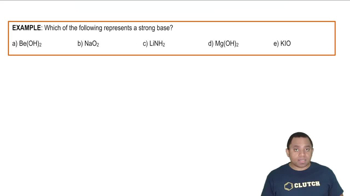
  • Which types of compounds are considered strong bases?

    Strong bases are compounds formed when Group 1A metals (except hydrogen and francium) or certain Group 2A metals (calcium, strontium, barium) combine with basic anions such as hydroxide (OH-), hydride (H-), amide (NH2-), or oxide (O2-).
  • Which Group 1A metals are excluded from forming strong bases and why?

    Hydrogen and francium are excluded because hydrogen is not a metal and francium is radioactive and unpredictable in behavior. Only lithium, sodium, potassium, rubidium, and cesium are included.
  • What happens to the charges when combining a Group 1A or 2A metal with a basic anion to form a strong base?

    If the charges are the same, they cancel out; if different, the numbers crisscross to balance the formula. This ensures the resulting compound is electrically neutral.
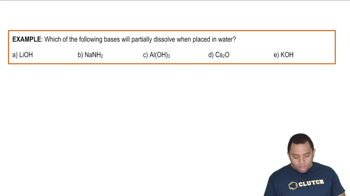
  • How does the dissociation of a weak base in water differ from that of a strong base?

    A weak base only partially dissociates in water, producing far fewer ions than a strong base. Most of the weak base remains in its molecular form, favoring the reactant side.
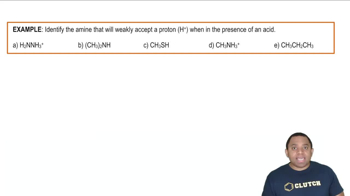
  • What structural feature distinguishes a neutral amine from a positively charged amine?

    A neutral amine contains nitrogen and hydrogen (and possibly carbon) without a formal charge. A positively charged amine has an extra proton, giving it a positive charge and making it a weak acid.
  • Why are beryllium, magnesium, and radium not included among Group 2A metals that form strong bases?

    Beryllium and magnesium do not form strong bases with basic anions, and radium is excluded due to its large size and unpredictable behavior. Only calcium, strontium, and barium are included.
  • What is the relationship between the strength of a base and its behavior as an electrolyte?

    Strong bases are strong electrolytes because they completely dissociate into ions in water. Weak bases are weak electrolytes since they only partially dissociate.