Chemical Bonds quiz #4 Flashcards
You can tap to flip the card.
Control buttons has been changed to "navigation" mode.
1/40
How do ionic bonds differ from covalent bonds?
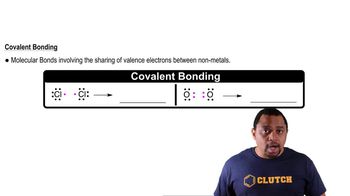
Ionic bonds involve the transfer of electrons between atoms, while covalent bonds involve the sharing of electrons.What happens when carbon bonds with oxygen?
When carbon bonds with oxygen, they typically form covalent bonds, such as in carbon dioxide (CO2).What determines whether an atom will form a chemical bond with another atom?
The tendency of an atom to achieve a filled outer shell determines whether it will form a chemical bond.Which statement describes how the bond between two oxygen atoms is formed?
The bond between two oxygen atoms is formed by sharing two pairs of electrons, creating a double covalent bond.What forms when two atoms combine?
When two atoms combine, they form a molecule or a compound, depending on the types of atoms involved.How many electrons are shared between two atoms in a triple bond?
Six electrons are shared between two atoms in a triple bond.How many electrons are shared in a double bond?
A double bond shares four electrons between two atoms.What is the number of electrons shared between the two atoms in an O2 molecule?
In an O2 molecule, four electrons are shared between the two oxygen atoms (double bond).The bond between which two atoms is most polar?
The bond between sodium and chlorine is most polar due to the large difference in electronegativity.When will oppositely charged atoms stick together?
Oppositely charged atoms stick together when they form an ionic bond.Which is a force that holds atoms together?
A chemical bond is the force that holds atoms together.Why are ionic compounds brittle?
Ionic compounds are brittle because the arrangement of ions can shift, causing repulsion between like charges and breaking the structure.What needs to occur in order for elements to form a compound?
Elements must undergo a chemical reaction and form chemical bonds to create a compound.What is the fundamental difference between covalent and ionic bonding?
Covalent bonding involves sharing electrons, while ionic bonding involves transferring electrons.How many electrons are shared in a triple covalent bond?
Six electrons are shared in a triple covalent bond.What is required for reactants to form bonds?
Reactants must interact so that electrons are transferred or shared to form chemical bonds.Which element is least likely to form chemical bonds?
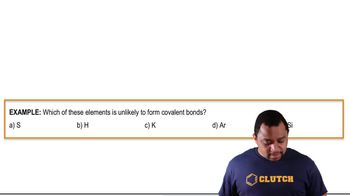
Noble gases are least likely to form chemical bonds because they have filled outer shells.What type of bond is most polar?
Ionic bonds are the most polar because they involve complete transfer of electrons.Which chemical bond is most polar?
An ionic bond is the most polar type of chemical bond.What type of bond holds together the nitrogen bases in DNA?
Hydrogen bonds hold together the nitrogen bases in DNA.Which of the following is a similarity between ionic and covalent bonds?
Both ionic and covalent bonds result in the formation of stable compounds.What will most likely happen when two bromine atoms bond together?
Two bromine atoms will share electrons to form a nonpolar covalent bond.What happens when chemical bonds break and new bonds form?
When chemical bonds break and new bonds form, a chemical reaction occurs.How many electrons are shared in a triple bond between two atoms?
Six electrons are shared in a triple bond between two atoms.How many covalent bonds does HN3 have?
HN3 (hydrazoic acid) has three covalent bonds between nitrogen atoms and hydrogen.What does the electron sea model for metals suggest?
The electron sea model suggests that valence electrons are free to move throughout the metal, allowing conductivity and malleability.Which bond is most polar?
An ionic bond, such as between sodium and chlorine, is most polar.How many covalent bonds can nitrogen form?
Nitrogen can form three covalent bonds.What is the force that holds atoms together?
Chemical bonds are the force that holds atoms together.What is the difference between ionic and covalent bonds?
Ionic bonds involve electron transfer; covalent bonds involve electron sharing.What do we call two or more atoms bonded together?
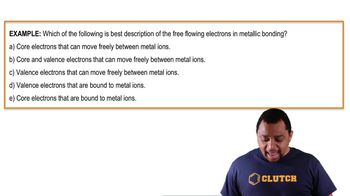
Two or more atoms bonded together are called a molecule.Which of the following best describes the arrangement of electrons in a metallic bond?
In a metallic bond, electrons are delocalized and move freely among metal ions.Which forces can be classified as intramolecular?
Ionic, covalent, and metallic bonds are classified as intramolecular forces.Which element will most likely form covalent bonds with fluorine?
Nonmetals such as hydrogen or carbon will most likely form covalent bonds with fluorine.Which of the following best describes two atoms of oxygen that are chemically bonded to each other?
Two oxygen atoms are bonded by a double covalent bond.What occurs when an atom of chlorine and an atom of hydrogen become a molecule of hydrogen chloride?
A polar covalent bond forms between chlorine and hydrogen.What is the number of electrons shared between the atoms in an I2 molecule?
Two electrons are shared between the atoms in an I2 molecule (single bond).Which of the following is used to bond parts together?
Chemical bonds are used to bond parts (atoms or ions) together.Why is there an attraction between the two ions in this chemical bond?
There is an attraction because opposite charges attract in an ionic bond.Which element can bond with titanium (Ti) to form a polar covalent bond?
A nonmetal with moderate electronegativity, such as oxygen, can bond with titanium to form a polar covalent bond.