Chemical Bonds quiz #5 Flashcards

Chemical Bonds quiz #5
Control buttons has been changed to "navigation" mode.
1/40
  • Which of the following compounds contains the weakest bonds to hydrogen?

    Compounds with hydrogen bonds, such as water, have weaker bonds to hydrogen compared to covalent or ionic bonds.
  • Which of the diatomic elements has a double bond between its atoms?

    Oxygen (O2) has a double bond between its atoms.
  • How many covalent bonds does carbon form if each of its unpaired electrons participates in one bond?

    Carbon forms four covalent bonds.
  • What is the function of electrons in chemical reactions?

    Electrons are transferred or shared to form chemical bonds during chemical reactions.
  • Will sulfur and oxygen atoms most likely form an ionic bond or a covalent bond?

    Sulfur and oxygen will most likely form a covalent bond.
  • How many bonds does one nitrogen make?

    Nitrogen typically makes three bonds.
  • What is the maximum number of covalent bonds an element with atomic number 8 can make with hydrogen?

    Oxygen (atomic number 8) can make two covalent bonds with hydrogen.
  • What determines the bond length of a covalent bond?

    Bond length is determined by the size of the atoms and the number of shared electron pairs.
  • How many electrons are shared in a single bond?

    Two electrons are shared in a single bond.
  • What type of bond will form in Cl2 in the excited state?

    Cl2 will form a covalent bond, typically a single bond.
  • What is the most significant factor in the formation of a covalent bond?

    The sharing of electrons to achieve a filled outer shell is the most significant factor.
  • Which one of the following bonds has the most ionic character?

    A bond between a metal and a nonmetal, such as sodium and chlorine, has the most ionic character.
  • Why does one atom of nitrogen form bonds with three atoms of hydrogen?

    Nitrogen has three unpaired electrons, allowing it to form three covalent bonds with hydrogen.
  • Which type of bond will vanadium atoms likely form with other vanadium atoms?

    Vanadium atoms will likely form metallic bonds with each other.
  • How many bonds would you expect to form between the two oxygen atoms?

    Two bonds (a double bond) form between two oxygen atoms.
  • How many bonds does each element usually form with other atoms in a compound?

    The number of bonds depends on the number of unpaired valence electrons each element has.
  • What is the difference between an ionic bond and a covalent bond?

    Ionic bonds involve electron transfer; covalent bonds involve electron sharing.
  • What are the differences between covalent and ionic bonds?

    Covalent bonds share electrons between nonmetals; ionic bonds transfer electrons from metals to nonmetals.
  • Which part of the atom is involved in chemical bonding?

    Valence electrons are involved in chemical bonding.
  • Which of the following is true of polar covalent bonds?

    Polar covalent bonds involve unequal sharing of electrons between atoms.
  • How many electrons are shared when two atoms form a triple bond?

    Six electrons are shared in a triple bond.
  • Which type of bond has elements with the greatest difference in electronegativity?

    Ionic bonds have the greatest difference in electronegativity.
  • How many electrons are in a single bond?

    A single bond contains two electrons.
  • How does the behavior of an electron change when it forms a covalent bond?

    Electrons are shared between atoms, occupying orbitals that overlap.
  • How many total electrons are shared in a double covalent bond?

    Four electrons are shared in a double covalent bond.
  • What determines the ionic or covalent character of a chemical bond?

    The difference in electronegativity between the atoms determines the bond's character.
  • What is the main difference between ionic and covalent bonds?

    Ionic bonds transfer electrons; covalent bonds share electrons.
  • When potassium and bromine atoms form chemical bonds, what type of bond is formed?

    Potassium and bromine form an ionic bond.
  • What is the difference between an ionic and covalent bond?

    Ionic bonds involve electron transfer; covalent bonds involve electron sharing.
  • How many single covalent bonds are elements in column F likely to form?

    Elements in column F (group 7A) typically form one single covalent bond.
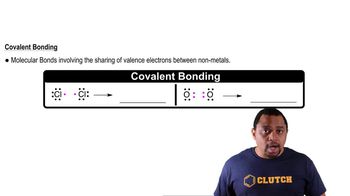
  • What happens when two oxygen atoms combine to form a molecule of oxygen?

    They share two pairs of electrons, forming a double covalent bond.
  • How many covalent bonds will a nitrogen atom normally make?

    A nitrogen atom normally makes three covalent bonds.
  • What is the main difference between an ionic and a covalent bond?

    Ionic bonds transfer electrons; covalent bonds share electrons.
  • What determines the number of covalent bonds that an atom can form?

    The number of unpaired valence electrons determines the number of covalent bonds.
  • The side-by-side overlap of p orbitals produces what kind of bond?

    Side-by-side overlap of p orbitals produces a pi (π) bond.
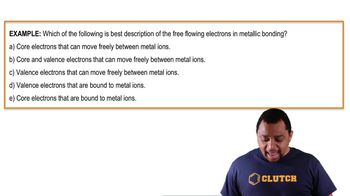
  • Which statement describes the electron sea model for metallic bonding?

    The electron sea model describes delocalized electrons moving freely among metal ions.
  • What type of bond would form between atoms of the following element? Iron (Fe)

    Iron atoms form metallic bonds.
  • What is an intramolecular force?

    An intramolecular force is a force that holds atoms together within a molecule, such as ionic, covalent, or metallic bonds.
  • How many covalent bonds can a carbon atom form?

    A carbon atom can form four covalent bonds.
  • What holds atoms together in a molecule?

    Chemical bonds hold atoms together in a molecule.