Chemical Bonds quiz #8 Flashcards

Chemical Bonds quiz #8
Control buttons has been changed to "navigation" mode.
1/40
  • What type of bond is forming here and what is its purpose?

    A chemical bond is forming to stabilize the atoms by achieving filled outer shells.
  • Are the bonds in each of the following substances ionic?

    Not all substances have ionic bonds; some have covalent or metallic bonds.
  • Which one of the following statements is true regarding bond characteristics?

    Bond strength and length depend on the type and number of shared electrons.
  • Which of the structures illustrated in the figure could not be formed by typical covalent bonds?

    Structures with more than four bonds to carbon cannot be formed by typical covalent bonds.
  • What is the value for q for forming all of the bonds in CH3COOH from separated atoms?

    The value for q is negative, indicating an exothermic process.
  • Click on sulfur. This element exists as rings. How many atoms is each sulfur atom bonded to?

    Each sulfur atom in a ring is bonded to two other sulfur atoms.
  • Which statement explains whether NaCl or BeO will have a stronger bond?

    BeO has a stronger bond due to higher charge and smaller ionic radii.
  • An atom bonds with another atom. What is the best classification for this reaction?

    This is a chemical reaction forming a compound.
  • What best explains whether bromine (Br) or neon (Ne) is more likely to form a covalent bond?

    Bromine is more likely because it does not have a filled outer shell, unlike neon.
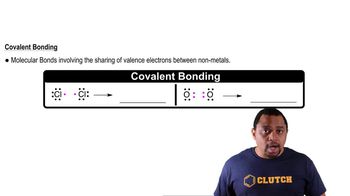
  • How do hydrogen and oxygen atoms form covalent bonds to create water?

    Hydrogen and oxygen share electrons to form covalent bonds, creating water.
  • What molecule would be created if these two elements bond? Carbon + oxygen

    Carbon and oxygen can form carbon dioxide (CO2) or carbon monoxide (CO).
  • What best describes the bonding in a carbon dioxide molecule?

    Carbon dioxide has double covalent bonds between carbon and each oxygen atom.
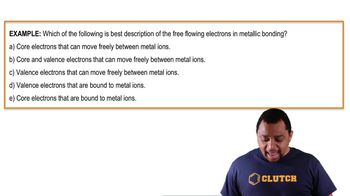
  • Which of the following best describes a metallic bond?

    A metallic bond is the attraction between delocalized electrons and metal ions.
  • Which element is likely to form exactly three covalent interactions with hydrogen?

    Nitrogen is likely to form three covalent bonds with hydrogen.
  • Which statement best describes the types of bonds shown in the diagram?

    The diagram shows covalent, ionic, or metallic bonds depending on the elements involved.
  • Which bonding method is used where strength and security are most critical?

    Ionic bonding is used where strength and security are critical due to strong electrostatic attraction.
  • How do electrons behave in a mineral with metallic bonding?

    Electrons are delocalized and move freely throughout the structure.
  • How would the model change as the atom forms bonds?

    The atom's valence electrons would be shared or transferred, changing its electron configuration.
  • Which part of an atom is actively exchanged or shared in a chemical bond?

    Valence electrons are actively exchanged or shared in a chemical bond.
  • What is the basis of a metallic bond?

    The basis of a metallic bond is the attraction between delocalized electrons and metal ions.
  • How do chemists describe the nature of metallic bonding?

    Chemists describe metallic bonding as a sea of delocalized electrons surrounding metal ions.
  • Which bond pair does not have a polar covalent bond?

    A bond between two identical atoms, such as H2, does not have a polar covalent bond.
  • The partial negative charge in a molecule of water occurs because

    Oxygen is more electronegative and attracts shared electrons more strongly.
  • What best explains how two oxygen atoms, each with six valence electrons, can bond with each other?

    They share two pairs of electrons, forming a double covalent bond.
  • Nonpolar covalent bonds are always formed from atoms that are __________.

    Nonpolar covalent bonds are formed from atoms that are identical or have similar electronegativities.
  • What determines the types of chemical reactions that an atom participates in?

    The number and arrangement of valence electrons determine the types of chemical reactions.
  • The partial negative charge in a molecule of water occurs because _____.

    Oxygen attracts shared electrons more strongly than hydrogen.
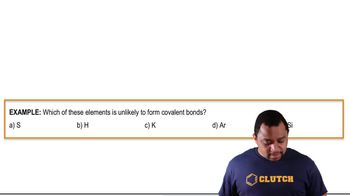
  • The element carbon (C) is most likely to form covalent bonds with the element

    Carbon is most likely to form covalent bonds with hydrogen, oxygen, or other nonmetals.
  • Which term best describes the role of hydrogen gas in the formation of a water molecule?

    Hydrogen acts as a reactant, forming covalent bonds with oxygen.
  • Hydrogen can form ______ covalent bond(s) and oxygen can form ______.

    Hydrogen can form one covalent bond; oxygen can form two.
  • The attraction of an atom for the electrons in a covalent bond is called its

    Electronegativity.
  • When atoms share electrons unequally the bond formed is a

    Polar covalent bond.
  • In a single molecule of water, two hydrogen atoms are bonded to a single oxygen atom by _____.

    Covalent bonds.
  • When two atoms are equally electronegative, they will interact to form

    A nonpolar covalent bond.
  • True or false: Electrons in covalent bonds are attracted to the nucleus of just one atom.

    False. Electrons in covalent bonds are attracted to the nuclei of both atoms.
  • The partial charges in a water molecule occur because of _____.

    Unequal sharing of electrons between oxygen and hydrogen.
  • Each carbon molecule can bond with as many as________ other atom(s) or molecule(s).

    Each carbon atom can bond with up to four other atoms.
  • When electrons are shared amongst all atoms, the resulting bond is a(n) ________ bond.

    Metallic bond.
  • Results from the unequal sharing of electrons between hydrogen and oxygen.

    A polar covalent bond results from the unequal sharing of electrons between hydrogen and oxygen.
  • Polar molecules have two regions with a slight positive charge

    Polar molecules have regions with slight positive and slight negative charges due to unequal electron sharing.