Chemical Properties quiz #12 Flashcards

Chemical Properties quiz #12
Control buttons has been changed to "navigation" mode.
1/40
  • Gasoline's ability to become a vapor correctly defines which of the following terms?
    Volatility is gasoline's ability to become a vapor.
  • An emetic drug would have which of the following actions?
    An emetic drug induces vomiting.
  • What is a natural source of pollution that eventually ends up in all groundwater?
    Mineral leaching is a natural source of groundwater pollution.
  • What do the symbols in parenthesis indicate? C7H16 (l) + 11O2 (g) → 7CO2 (g) + 8H2O (l)
    The symbols indicate the physical state: liquid, gas, or solid.
  • What is the term for a water-soluble flammable liquid?
    Alcohol is a water-soluble flammable liquid.
  • Which statement regarding calcium is false?
    Calcium is not a gas at room temperature; this is false.
  • Which action is done by the slightly charged parts of a water molecule in a salt solution?
    They surround and dissolve the ions.
  • Malonic acid is a strong irritant and a corrosive. True or false?
    True, malonic acid is a strong irritant and corrosive.
  • What should be done to the end of the filler rod if it becomes oxidized?
    Clean the oxidized end before use.
  • The molecule found in CFCs and HCFCs that depletes ozone is:
    Chlorine is the molecule that depletes ozone.
  • Which of these minerals would be the main component in the cement slab in your house?
    Gypsum is a main component in cement.
  • Non-organic foods are often sprayed with pesticides. What is a pesticide?
    A pesticide is a chemical used to kill pests.
  • What is the typical mechanism of action for chemical food preservatives?
    They inhibit microbial growth by chemical reactions.
  • What role do water and other volatiles play in the formation of magma?
    They lower the melting point and aid in magma formation.
  • Which type of reaction occurs when a compound is separated into its elements?
    A decomposition reaction separates a compound into its elements.
  • Which of the following is a clue of a chemical change?
    Formation of a precipitate is a clue of a chemical change.
  • Which of the following is a clue that a chemical change has occurred?
    Color change is a clue that a chemical change has occurred.
  • Which of these elements reacts rapidly when dropped in water?
    Sodium reacts rapidly when dropped in water.
  • What do we call the study of matter and how matter changes?
    Chemistry is the study of matter and its changes.
  • Which of the following correctly describes a compound?
    A compound is made of two or more elements chemically combined.
  • What does the symbol Δ in a chemical equation mean?
    Δ means heat is added to the reaction.
  • Which of the following is not a property of an ionic compound?
    Ionic compounds do not conduct electricity in solid form.
  • Which of these does a fire need to burn?
    A fire needs fuel, oxygen, and heat.
  • What gas made Davy sick for 48 hours and almost killed him?
    Nitrous oxide made Davy sick.
  • Which greenhouse gas typically exists in both the stratosphere and the troposphere?
    Ozone exists in both the stratosphere and troposphere.
  • How many hydrogen bonds can a single water molecule form?
    A single water molecule can form up to four hydrogen bonds.
  • Nonpolar molecules that cluster away from water molecules are called __________ molecules.
    They are called hydrophobic molecules.
  • Water is a ______ molecule.
    Water is a polar molecule.
  • Which statement explains one way that minerals form?
    Minerals can form by precipitation from solution.
  • In a water molecule, the most electronegative atom is ______.
    Oxygen is the most electronegative atom.
  • The bicarbonate ion is an example of a(n) __________.
    It is an example of a polyatomic ion.
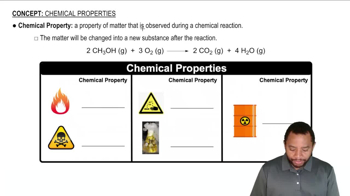
  • A characteristic of a pure substance that describes its ability to change into different substances
    A chemical property describes this ability.
  • A water molecule can bond to up to how many other water molecules?
    A water molecule can bond to up to four other water molecules.
  • In the term trace element the adjective trace means that
    Trace means present in very small amounts.
  • A client's mouth might have a metallic taste after treatment with a
    After treatment with a metal-based compound.
  • Carbon and hydrogen are ______ elements.
    Carbon and hydrogen are nonmetal elements.
  • Does C6H12O6 dissociate in water?
    No, C6H12O6 dissolves but does not dissociate into ions.
  • Which chemical reaction involves the fewest oxygen atoms?
    Combustion of methane involves fewer oxygen atoms than other reactions.
  • The oxygen side of a water molecule is _____. Slightly negative, slightly positive, neutral
    The oxygen side is slightly negative.
  • Match the following chemical with its function: Ca2+.
    Ca2+ is important for bone strength and muscle function.