Chemical Properties quiz #5 Flashcards

Chemical Properties quiz #5
Control buttons has been changed to "navigation" mode.
1/40
  • Which chemical property means the ability to catch and sustain a fire?
    Flammability means the ability to catch and sustain a fire.
  • Which of the following is true about compounds?
    Compounds have properties different from the elements that form them.
  • How could you distinguish an element from a compound?
    An element cannot be broken down by chemical means, but a compound can.
  • What is a characteristic property?
    A characteristic property is a property that helps identify a substance, such as flammability or reactivity.
  • What was the color change when mercury (II) oxide was heated?
    Mercury (II) oxide changes from red-orange to metallic silver when heated.
  • Which of these is a qualitative observation?
    Noting a color change is a qualitative observation.
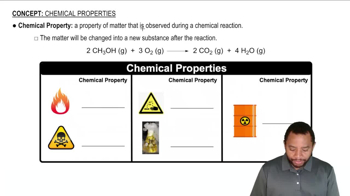
  • Is flammability a physical or chemical property?
    Flammability is a chemical property.
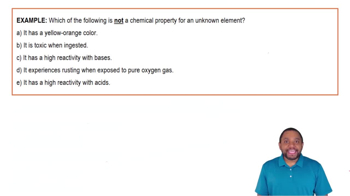
  • Which of the following is a chemical property of a substance?
    Reactivity with acids is a chemical property.
  • Which of the following compounds does not exhibit covalent (molecular) bonding?
    NaCl does not exhibit covalent bonding; it is ionic.
  • Which of the following is a definite indicator of a chemical change?
    Formation of a new substance is a definite indicator of a chemical change.
  • Which of these is not a sign of a chemical reaction?
    A change in state without a new substance forming is not a sign of a chemical reaction.
  • Sulfur cannot conduct electricity. Why not?
    Sulfur cannot conduct electricity because it lacks mobile electrons.
  • Inorganic compounds typically do not contain which atoms?
    Inorganic compounds typically do not contain carbon-hydrogen bonds.
  • A calorie and a kilocalorie are both equivalent to how many calories?
    A kilocalorie is equivalent to 1,000 calories.
  • What element is used to disinfect swimming pools?
    Chlorine is used to disinfect swimming pools.
  • Which of the following properties of copper are chemical properties?
    Copper's ability to react with oxygen and form copper oxide is a chemical property.
  • Which of the following are evidence that a chemical change has occurred?
    Evidence includes color change, gas production, and formation of a precipitate.
  • What two elements make up the majority of the air on Earth?
    Nitrogen and oxygen make up the majority of Earth's air.
  • What kind of change causes iron to rust?
    A chemical change causes iron to rust.
  • Which compound is a CFC or chlorofluorocarbon?
    CCl2F2 is a chlorofluorocarbon (CFC).
  • What is a property of an ionic compound?
    Ionic compounds conduct electricity when dissolved in water.
  • What are the two compounds that are formed when nitrogen combines with oxygen?
    Nitrogen combines with oxygen to form nitrogen monoxide (NO) and nitrogen dioxide (NO2).
  • Which substance is the most basic?
    Sodium hydroxide (NaOH) is a highly basic substance.
  • What gas was used to fill the Hindenburg?
    Hydrogen gas was used to fill the Hindenburg.
  • Which type of change must occur to form a compound?
    A chemical change must occur to form a compound.
  • Which mineral bubbles when acid is placed on it?
    Calcite (calcium carbonate) bubbles when acid is placed on it.
  • What properties of metals are explained by its mobile electrons?
    Mobile electrons explain metals' electrical conductivity and malleability.
  • What do you observe when you combine baking soda solution and calcium chloride solution?
    A precipitate forms, indicating a chemical reaction.
  • Which of the following is a property of a non-metal?
    Non-metals are generally poor conductors of electricity.
  • Which of the following is an inorganic molecule?
    Carbon dioxide (CO2) is an inorganic molecule.
  • Is elephant toothpaste a physical or chemical reaction?
    Elephant toothpaste is a chemical reaction.
  • Which element reacts violently with water?
    Sodium reacts violently with water.
  • Hard water mostly contains which of the following minerals?
    Hard water contains calcium and magnesium minerals.
  • The poisonous gas produced by the exhaust system is called what?
    Carbon monoxide is the poisonous gas produced by exhaust systems.
  • What are the indicators of a chemical reaction?
    Indicators include color change, gas production, and formation of a precipitate.
  • Which property of rubbing alcohol is a chemical property?
    Rubbing alcohol's flammability is a chemical property.
  • What do the small numbers (subscripts) in the codes represent?
    Subscripts represent the number of atoms of each element in a compound.
  • Which of the following includes an example of a chemical property of an element?
    Flammability is a chemical property of an element.
  • Which chemical is added to many municipal water supplies to help prevent tooth decay?
    Fluoride is added to municipal water supplies to prevent tooth decay.
  • Which of the following describes a chemical property of water?
    Water's ability to react with sodium to produce hydrogen gas is a chemical property.