Chemical Properties quiz #9 Flashcards

Chemical Properties quiz #9
Control buttons has been changed to "navigation" mode.
1/40
  • Which of the following is not true of zinc?
    Zinc does not react violently with water.
  • What is the primary reason that NH3(aq) is added to the dissolved penny solution in this experiment?
    NH3(aq) acts as a complexing agent to keep copper ions in solution.
  • Can you test gold with a lighter?
    No, testing gold with a lighter is not a reliable chemical test.
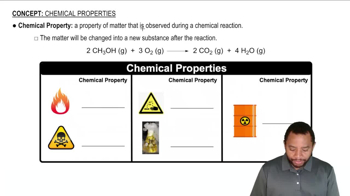
  • Which of these is considered a visual sign of potential chemical hazard?
    A pictogram with a flame or skull and crossbones is a visual sign of chemical hazard.
  • Which is considered a chemical mutagen? Tanning beds, tobacco, x-rays, sunlight
    Tobacco and x-rays are considered chemical mutagens.
  • Which of these substances contributes to soap's slippery texture? An acid, a base, carbonate, water
    A base contributes to soap's slippery texture.
  • Which compound has the highest melting point? Al2(CO3)3, C12H22O11, C8H18, H2O
    Al2(CO3)3 has the highest melting point.
  • When baking soda and vinegar react, what is produced?
    Carbon dioxide gas is produced.
  • Are chemical hazards always visible?
    No, chemical hazards are not always visible.
  • Which compound most likely contains polar covalent bonds? NaCl, AlF3, Br2, NF3
    NF3 most likely contains polar covalent bonds.
  • What are the potential chemical hazards of a sprayed paint mist in a work environment?
    Potential hazards include inhalation of toxic chemicals and flammability.
  • Which of the following would most likely utilize a particulate control device?
    Industrial smokestacks would utilize a particulate control device.
  • Which condition(s) contribute to engine deposits?
    Incomplete combustion and chemical reactions contribute to engine deposits.
  • Which best describes most covalent compounds? Resilient, brittle, cold, warm
    Most covalent compounds are brittle.
  • Which of these elements is found in both carbohydrates and water? Carbon, oxygen, nitrogen, helium
    Oxygen is found in both carbohydrates and water.
  • Which common item is made from copper? Soap, coins, baby powder, colored pencils
    Coins are commonly made from copper.
  • What is the outcome of all chemical changes when two substances are combined?
    A new substance is formed.
  • Which statement describes how chemical formulas represent compounds?
    Chemical formulas show the types and numbers of atoms in a compound.
  • Which statement best compares the melting point of butane (C4H10) with that of octane (C8H18)?
    Octane has a higher melting point than butane due to larger molecular size.
  • What is cobalt oxide?
    Cobalt oxide is a compound formed from cobalt and oxygen.
  • What is the best reason for the difference in properties of LiCl and C6H14O?
    LiCl is ionic and C6H14O is covalent, leading to different properties.
  • Which gas in Earth's atmosphere forms ozone?
    Oxygen gas forms ozone in the atmosphere.
  • What must be done to the refrigerant that is vented off the top when filling a charging cylinder?
    It must be properly captured and not released into the atmosphere.
  • Consider the compound Al(OH)3. What type of solid does it form? Crystal lattice, glass, metal, molecule
    Al(OH)3 forms a crystal lattice.
  • What is the most likely reason that nonmetals are electrical insulators?
    Nonmetals lack mobile electrons.
  • What is one use of the mineral gypsum? Salt, baby powder, wallboard, lubricants
    Gypsum is used to make wallboard.
  • Which method of testing substances is a sure way to identify a chemical reaction?
    Observing the formation of a new substance is a sure way to identify a chemical reaction.
  • Which of the following can block some UV rays?
    Ozone can block some UV rays.
  • What is a convection cell?
    A convection cell is a pattern of fluid movement caused by temperature differences.
  • What is the product of water splitting?
    Water splitting produces hydrogen and oxygen gases.
  • What were the effects of the poison gas?
    Poison gas can cause chemical burns and respiratory damage.
  • Which chemical in vaping aerosol can cause popcorn lung?
    Diacetyl in vaping aerosol can cause popcorn lung.
  • Which refrigerants can be mixed in an appliance?
    Only refrigerants with similar chemical properties can be mixed.
  • Which of the following is most likely the source of the radon found in a house?
    Radon comes from the natural decay of uranium in soil.
  • The chemical categories using danger and warning (signal words) identify which of the following?
    They identify the toxicity and hazard level of chemicals.
  • Why is the Dead Sea so salty and full of minerals?
    High evaporation rates concentrate salts and minerals.
  • What is formed when two or more non-mixable substances are united with the help of a binder?
    An emulsion is formed.
  • What is the active chemical compound in alcohol?
    Ethanol is the active chemical compound in alcohol.
  • Particulates can be removed from smokestack emissions by which of the following methods?
    Filtration or electrostatic precipitators can remove particulates.
  • Which of these is a chemical property of a substance? Texture, ductility, reactivity, conductivity
    Reactivity is a chemical property.