Skip to main content
General Chemistry
My Course
Learn
Exam Prep
AI Tutor
Study Guides
Textbook Solutions
Flashcards
Explore
My Course
Learn
Exam Prep
AI Tutor
Study Guides
Textbook Solutions
Flashcards
Explore
Back
Combustion Analysis quiz
You can tap to flip the card.
Define:
What is the main purpose of combustion analysis in chemistry?
You can tap to
flip the card.
👆
What is the main purpose of combustion analysis in chemistry?
Combustion analysis is used to determine the empirical formula of a compound by analyzing the products of its combustion reaction.
Track progress
Control buttons has been changed to "navigation" mode.
1/15
Related flashcards
Related practice
Recommended videos
Combustion Analysis definitions
Combustion Analysis
13 Terms
Combustion Analysis quiz
Combustion Analysis
9 Terms
Combustion Analysis quiz #1
Combustion Analysis
40 Terms
Combustion Analysis
3. Chemical Reactions
5 problems
Topic
Jules
3. Chemical Reactions - Part 1 of 3
5 topics
13 problems
Chapter
Jules
3. Chemical Reactions - Part 2 of 3
6 topics
13 problems
Chapter
Jules
3. Chemical Reactions - Part 3 of 3
5 topics
13 problems
Chapter
Jules
Guided course
02:09
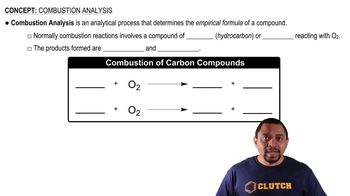
Empirical Formula via Combustion
Jules Bruno
6770
views
76
rank
1
comments
Guided course
5:59
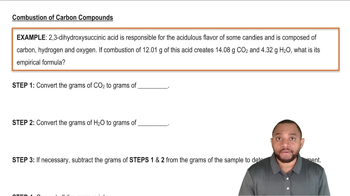
Combustion of Carbon Compounds Example
Jules Bruno
3947
views
70
rank
4
comments
Guided course
01:29
Combustion of Non-Hydrocarbons
Jules Bruno
3590
views
39
rank
1
comments
Terms in this set (15)
Hide definitions
What is the main purpose of combustion analysis in chemistry?
Combustion analysis is used to determine the empirical formula of a compound by analyzing the products of its combustion reaction.
Which two elements are present in all hydrocarbons?
Hydrocarbons contain only carbon and hydrogen.
What are the typical products formed when a hydrocarbon undergoes combustion?
The typical products are carbon dioxide (CO2) and water (H2O).
What additional element is present in compounds like glucose that are not pure hydrocarbons?
Compounds like glucose contain oxygen in addition to carbon and hydrogen.
When a compound containing carbon, hydrogen, and oxygen combusts, what are the main products?
The main products are still carbon dioxide (CO2) and water (H2O).
What is the molecular formula of octane, a common hydrocarbon?
The molecular formula of octane is C8H18.
What is the molecular formula of glucose?
The molecular formula of glucose is C6H12O6.
What gaseous products can be formed during the combustion of compounds containing sulfur?
Sulfur-containing compounds can produce sulfur dioxide (SO2) during combustion.
Which gaseous product is formed from the combustion of nitrogen-containing compounds?
Nitrogen-containing compounds can produce nitrogen dioxide (NO2) during combustion.
What are halogens, and which elements are included in this group?
Halogens are elements from group 7A, including fluorine, chlorine, bromine, and iodine.
What diatomic molecules can be produced from the combustion of halogen-containing compounds?
Diatomic molecules such as F2, Cl2, Br2, and I2 can be produced.
How does the combustion analysis of non-hydrocarbons differ from that of hydrocarbons?
Non-hydrocarbons can produce additional products like SO2, NO2, and halogen diatomic molecules, not just CO2 and H2O.
Why is it important to know the typical products of combustion reactions in combustion analysis?
Knowing the typical products helps accurately determine the empirical formula of the original compound.
What is the main difference in combustion products between hydrocarbons and compounds containing elements like sulfur or nitrogen?
Hydrocarbons produce only CO2 and H2O, while compounds with sulfur or nitrogen can also produce SO2 or NO2.
What is the empirical formula, and how is it related to combustion analysis?
The empirical formula is the simplest whole-number ratio of elements in a compound, which combustion analysis helps determine.
 BackBack
 02:09
02:09