Density of Geometric Objects quiz #1 Flashcards

Density of Geometric Objects quiz #1
Control buttons has been changed to "navigation" mode.
1/10
  • How does the density of a gas depend on temperature?
    As temperature increases, the volume of a gas expands (if pressure is constant), causing its density to decrease because density equals mass divided by volume.
  • What is the volume of a table tennis ball in cm³, assuming it is a sphere with a typical diameter of 4.0 cm?
    The radius is 2.0 cm. Volume = (4/3) × π × (2.0 cm)³ ≈ 33.5 cm³.
  • You have a 100 gram sample of each of the following metals: gold (density = 19.3 g/cm³), silver (density = 10.5 g/cm³), and aluminum (density = 2.70 g/cm³). Which sample has the largest volume?
    Aluminum has the largest volume because it has the lowest density. Volume = mass/density, so 100 g / 2.70 g/cm³ ≈ 37.0 cm³.
  • A cube measures 12.5 inches on a side. What is its volume in cubic centimeters?
    First, convert inches to centimeters: 12.5 in × 2.54 cm/in = 31.75 cm. Volume = (31.75 cm)³ ≈ 32,000 cm³.
  • If a cube has sides of 3 nm, what is its volume in cubic nanometers?
    Volume = (3 nm)³ = 27 nm³.
  • What is the volume of a cube with dimensions 11.0 cm × 11.0 cm × 11.0 cm in m³?
    Volume = (11.0 cm)³ = 1,331 cm³. Convert to m³: 1,331 cm³ × (1 m/100 cm)³ = 0.001331 m³.
  • If a cube has sides of 3 nm, what are the surface area and the volume of the cube?
    Surface area = 6 × (3 nm)² = 54 nm²; Volume = (3 nm)³ = 27 nm³.
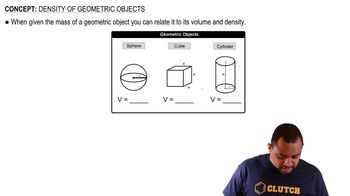
  • What does the variable 'a' represent in the volume formula for a cube?
    'a' represents the length of one edge of the cube, and all edges are assumed to be equal in length.
  • Why is it usually unnecessary to memorize the volume formulas for geometric objects in chemistry?
    Volume formulas are typically provided by instructors within questions or on formula sheets, so memorization is not required.
  • In the context of a sphere, how is the radius defined?
    The radius of a sphere is the distance from its center to its edge.