Dilutions quiz #1 Flashcards

Dilutions quiz #1
Control buttons has been changed to "navigation" mode.
1/37
  • How do you find the dilution factor of the final step in comparison to the original sample?

    The dilution factor is calculated by dividing the final volume by the initial volume or by dividing the initial concentration by the final concentration.
  • Which equation can be used to calculate the dilution of a solution?

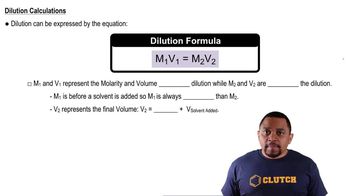
    The equation M1V1 = M2V2 is used to calculate the dilution of a solution.
  • How much concentrated solution would it take to prepare 1.15 L of 0.115 M HNO3 by mixing with water?

    Use M1V1 = M2V2; V1 = (M2 × V2) / M1. Substitute the values to find the required volume of concentrated solution.
  • What formula would you use to prepare a dilute solution from a concentrated solution?

    Use the dilution formula: M1V1 = M2V2.
  • How can you create a more dilute solution?

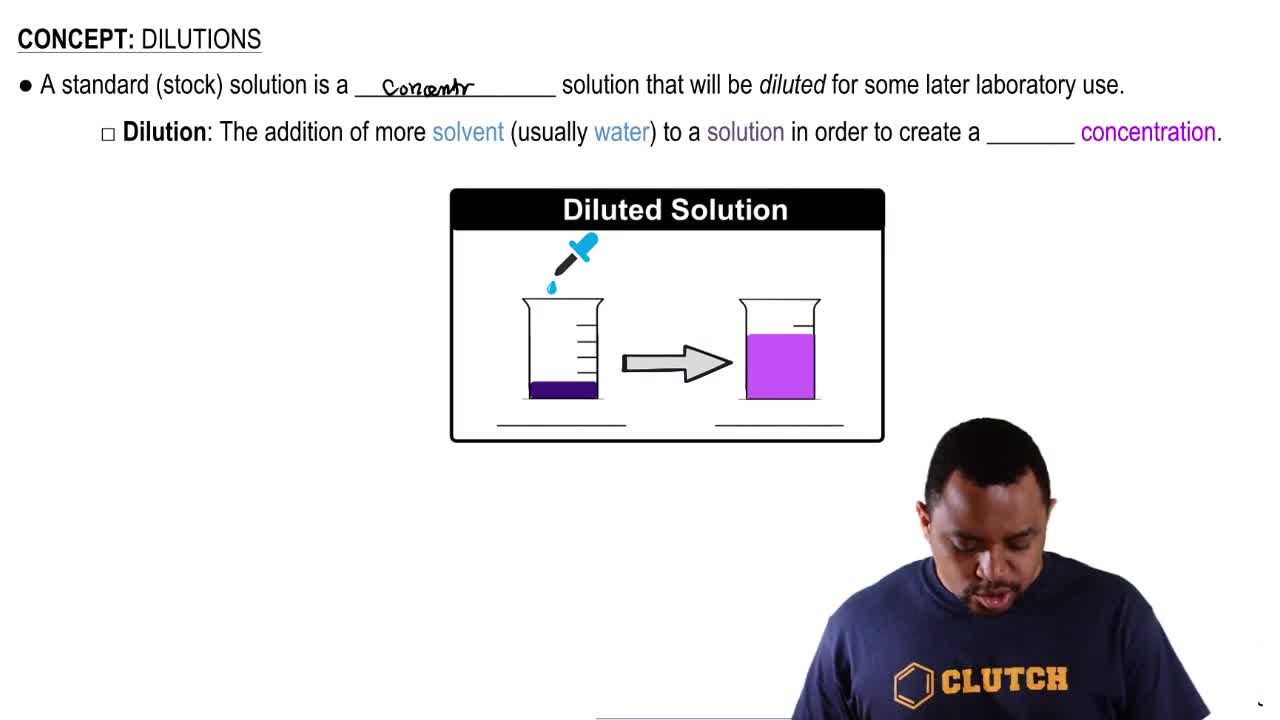
    Add more solvent, typically water, to the original solution.
  • Suppose a solution is dilute. What can be said of this solution?

    A dilute solution has a lower concentration of solute compared to a concentrated solution.
  • How is a stock solution used?

    A stock solution is diluted by adding solvent to prepare solutions of lower concentration for laboratory use.
  • What volume of a 1.00 M HCl solution is required to create 200.0 mL of a 0.250 M HCl solution?

    Use M1V1 = M2V2; V1 = (0.250 M × 200.0 mL) / 1.00 M = 50.0 mL.
  • Which of the following stays constant when diluting a solution?

    The amount of solute stays constant during dilution.
  • Why does the dilution equation M1V1 = M2V2 work?

    It works because the amount of solute before and after dilution remains the same; only the volume and concentration change.
  • What do M1 and V1 represent in the dilution equation?

    M1 is the initial molarity (concentration) and V1 is the initial volume before dilution.
  • In the equation M1V1 = M2V2, what does each term represent?

    M1 and V1 are the initial concentration and volume; M2 and V2 are the final concentration and volume after dilution.
  • How much of a 0.250 M sucrose solution must be used to prepare 400.0 mL of a 0.0310 M solution?

    Use M1V1 = M2V2; V1 = (0.0310 M × 400.0 mL) / 0.250 M = 49.6 mL.
  • Which statement best describes the process of making a solution by diluting a stock solution?

    Diluting a stock solution involves adding solvent to a concentrated solution to achieve a desired lower concentration.
  • A 0.1 M solution is diluted by three orders of magnitude. What is the new concentration?

    The new concentration is 0.0001 M (or 1 × 10⁻⁴ M).
  • What volume of 2.5 M nitric acid (HNO3) is required to prepare 500 mL of a 0.20 M HNO3 solution?

    Use M1V1 = M2V2; V1 = (0.20 M × 500 mL) / 2.5 M = 40 mL.
  • Is dilution directly or indirectly related to molarity?

    Dilution is indirectly related to molarity; as dilution increases, molarity decreases.
  • Which of the following correctly describes how to make a 10% v/v solution of ethanol?

    Mix 10 mL of ethanol with enough solvent to make a total volume of 100 mL.
  • What volume of 18 M sulfuric acid must be used to prepare 1.80 L of 0.215 M H2SO4?

    Use M1V1 = M2V2; V1 = (0.215 M × 1800 mL) / 18 M = 21.5 mL.
  • What volume of concentrated (14.7 M) phosphoric acid is needed to prepare 25.0 L of 3.0 M H3PO4?

    Use M1V1 = M2V2; V1 = (3.0 M × 25,000 mL) / 14.7 M ≈ 5,102 mL.
  • Which of the following will decrease the concentration of a solution? Select all that apply.

    Adding more solvent (such as water) will decrease the concentration of a solution.
  • What volume of 7.50 M HNO3 should be diluted to prepare 25.00 mL of a 2.00 M HNO3 solution?

    Use M1V1 = M2V2; V1 = (2.00 M × 25.00 mL) / 7.50 M = 6.67 mL.
  • What volume in milliliters of concentrated HCl (12 M) is needed to make 1500 mL of a 3.5 M solution?

    Use M1V1 = M2V2; V1 = (3.5 M × 1500 mL) / 12 M = 437.5 mL.
  • What volume of 5.00 M KI stock solution is needed to make 250 mL of a 1.50 M solution?

    Use M1V1 = M2V2; V1 = (1.50 M × 250 mL) / 5.00 M = 75 mL.
  • What is the new concentration when 5.4 mL of 1.0 M HCl is mixed with 60.0 mL water?

    Total volume = 5.4 mL + 60.0 mL = 65.4 mL; M2 = (1.0 M × 5.4 mL) / 65.4 mL ≈ 0.0826 M.
  • If 100 mL of a 2.0 M solution is diluted to be a 0.66 M solution, what is the final volume?

    Use M1V1 = M2V2; V2 = (2.0 M × 100 mL) / 0.66 M ≈ 303 mL.
  • 900 mL of water is added to 100 mL of a 0.1 M solution. What is the new concentration?

    Total volume = 100 mL + 900 mL = 1000 mL; M2 = (0.1 M × 100 mL) / 1000 mL = 0.01 M.
  • A series of 4 × 10-fold dilutions will yield which final dilution?

    A 10,000-fold dilution (10⁴ times less concentrated than the original).
  • What volume of 9.00 M nitric acid is needed to make 6.50 L of 1.25 M solution?

    Use M1V1 = M2V2; V1 = (1.25 M × 6500 mL) / 9.00 M ≈ 903 mL.
  • How much of a 0.250 M sucrose solution must be used to prepare 400.0 mL of a 0.0310 M solution?

    Use M1V1 = M2V2; V1 = (0.0310 M × 400.0 mL) / 0.250 M = 49.6 mL.
  • To make 2.00 L of 0.300 M sulfuric acid from a concentrated solution, what calculation should you perform?

    Use M1V1 = M2V2 to find the volume of concentrated solution needed.
  • How many milliliters of a 25% (m/v) NaOH solution would contain 75 g of NaOH?

    Volume = mass / concentration = 75 g / (25 g/100 mL) = 300 mL.
  • How much 0.075 M NaCl solution can be made by diluting 450 mL of 9.0 M NaCl?

    Use M1V1 = M2V2; V2 = (9.0 M × 450 mL) / 0.075 M = 54,000 mL.
  • What volume of a 0.100 M HCl stock solution should be used to prepare 250.00 mL of 0.0250 M HCl?

    Use M1V1 = M2V2; V1 = (0.0250 M × 250.00 mL) / 0.100 M = 62.5 mL.
  • How do you convert milimolar (mM) to molar (M) concentration?

    Divide the milimolar value by 1000 to get molar concentration.
  • You need to use a dilute hydrochloric acid solution in an experiment. How would you prepare it from a concentrated stock?

    Calculate the required volume using M1V1 = M2V2 and add solvent to reach the desired concentration.
  • Convert the concentration of a solution from one unit to another (e.g., mM to M). How is this done?

    To convert mM to M, divide by 1000; to convert M to mM, multiply by 1000.